SUV Loan Rates in 2026: Benchmarks by Credit Tier

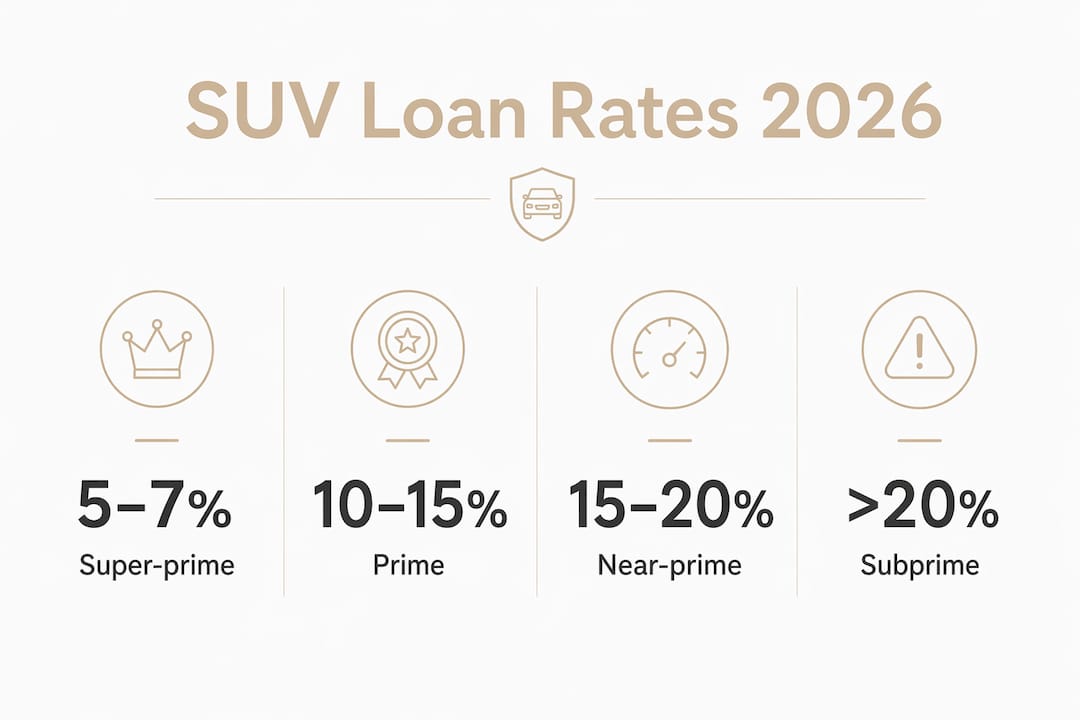
For a 60-month new SUV loan as of July 2026, super-prime borrowers (credit scores 781+) typically see APRs in the 5–7% range, while subprime borrowers (credit scores below 601) face rates of 14–20% and sometimes higher. Used SUV loans run roughly 2–3 percentage points above comparable new-vehicle rates at every credit tier. Here is a quick orientation before you read the full breakdown:
- Super-prime (781+): 5–7% APR on a new SUV, 7–10% used
- Prime (661–780): 7–10% new, 9–13% used
- Nonprime (601–660): 10–14% new, 13–17% used
- Subprime (below 601): 14–20%+ new, 17–22%+ used
If your dealer’s quote falls outside the range for your credit tier, the immediate move is to benchmark it. Run your offer through Baywall or get a preapproval from a bank or credit union before you sign anything. U.S. News and TrueCar both track current market rates and manufacturer promotions, but neither tells you whether your specific offer is fair for your credit profile. That is exactly what Baywall does.
Table of Contents
- Current SUV loan rates by credit score and vehicle type
- How loan term and vehicle type change what you actually pay
- What counts as a good APR for your credit score band
- What lenders look at when pricing an SUV loan
- Worked example: $30,000 SUV loan across APRs and terms
- How to get a lower APR before you sign
- When refinancing an SUV loan makes sense
- Common APR myths and mistakes buyers make at the dealership
- How to benchmark your dealer’s SUV APR in minutes using Baywall
- Key Takeaways
- Your dealer’s APR quote deserves a second opinion
Current SUV loan rates by credit score and vehicle type
The table below reflects average APR ranges for 60-month loans as of July 2026, based on market-rate reporting from NerdWallet and U.S. News. These are market benchmarks, not lender-specific quotes.
| Credit Tier | Score Range | New SUV APR | Used SUV APR |
|---|---|---|---|
| Super-prime | 781+ | 5–7% | 7–10% |
| Prime | 661–780 | 7–10% | 9–13% |
| Nonprime | 601–660 | 10–14% | 13–17% |
| Subprime | below 601 | 14–20%+ | 17–22%+ |
| Deep subprime | — | 20%+ | 22%+ |
Rate note: These ranges reflect standard financing. Manufacturer-subvented rates (including 0% APR offers) can fall well below these figures for qualified buyers, but eligibility is typically reserved for super-prime applicants and specific trims. The next section explains how term length shifts these numbers.
Used and refinance loans carry higher APRs because lenders price in greater risk: older vehicles depreciate faster, collateral value is harder to pin down, and loan-to-value ratios tend to be less favorable. A used SUV loan at the prime tier often costs as much in rate as a nonprime new-vehicle loan.

How loan term and vehicle type change what you actually pay
The APR is only part of the story. The term you choose determines both your monthly payment and the total interest you hand over across the life of the loan.
Standard term buckets and the tradeoff:
- 36 months: Highest monthly payment, lowest total interest. Best for buyers who can absorb the payment and want to minimize cost.
- 48 months: A middle ground that reduces monthly payment modestly while keeping total interest reasonable.
- 60 months: The most common term for SUV financing. Monthly payments are manageable, but total interest climbs noticeably compared to 36 or 48 months.
- 72 months: Monthly payment drops further, but total interest can exceed the 60-month version by thousands of dollars. Lenders also typically charge a slightly higher APR for longer terms because the risk window is wider.
Why used and refinance loans cost more:
Used vehicles lose value faster than new ones, which means a lender’s collateral cushion shrinks more quickly. If a buyer defaults in year three on a 72-month used-SUV loan, the vehicle may be worth less than the remaining balance. Lenders price that risk into the rate. Refinance loans carry similar logic: the vehicle is already aged, and the lender is stepping into a loan mid-stream.
Quick comparison: 48 vs. 72 months on a $30,000 loan at 8% APR
- 48 months: ~$732/month, total interest paid ~$5,136
- 72 months: ~$521/month, total interest paid ~$7,512
That $211 monthly savings costs you an extra $2,376 over the life of the loan. Whether that tradeoff makes sense depends on your cash flow, but it is worth calculating before you commit.

What counts as a good APR for your credit score band
There is no single “good” APR. What is competitive for a prime borrower is a terrible rate for someone with a super-prime score, and what looks high for a nonprime buyer might actually be below market for subprime credit. Context is everything.
Rough benchmarks by tier:
- Super-prime: Anything above 8% on a new SUV deserves a second look. Buyers in this tier have real leverage and should expect rates at or near the lowest standard offers.
- Prime: A rate in the 7–9% range is competitive. Above 11% warrants pushback or a competing preapproval.
- Nonprime: Rates in the 10–13% range are typical. If a dealer quotes above 15%, ask for the rate sheet or shop a credit union.
- Subprime: Rates above 20% are common but not inevitable. Credit unions and community banks sometimes offer better terms than dealer-arranged financing for this tier.
Manufacturer promotional rates change the math entirely. U.S. News lists 0% APR deals on select 2026 SUV models for July 2026, and TrueCar flags 148 SUV models with special financing rates this month, including 0% on models like the Hyundai Tucson and Kia Sportage. Those offers are real, but they are typically limited to top-tier credit applicants and specific trims. A buyer who does not qualify gets auto-assigned a standard rate, often without being told the 0% was ever on the table.
Pro Tip: Never evaluate an offer by monthly payment alone. Compare total cost: APR multiplied across the full term, plus any fees rolled into the loan. A lower monthly payment on a longer term can easily cost you $2,000–$4,000 more over the life of the loan.
What lenders look at when pricing an SUV loan
Lenders do not set rates arbitrarily. Every APR offer reflects a risk calculation built from several factors you can influence before you walk into a dealership.
- Credit score: The single biggest driver. A 30-point improvement in your score can shift your offered APR by a full percentage point or more.
- Debt-to-income ratio (DTI): Lenders want to see that your total monthly debt obligations, including the new loan payment, stay below roughly 40–45% of gross monthly income. A high DTI signals repayment risk even when the credit score is strong.
- Loan-to-value ratio (LTV): If you are financing 100% of a vehicle’s value with no down payment, the lender has no cushion if you default. A 10–20% down payment lowers LTV and often earns a better rate.
- Vehicle age and mileage (used loans): Most lenders cap financing on vehicles over 7–10 years old or above 100,000–120,000 miles. Older vehicles attract higher rates because collateral value is less predictable.
- Loan term: Longer terms carry slightly higher APRs at most lenders because default risk compounds over time.
- Employment and income documentation: Pay stubs, W-2s, or tax returns for self-employed buyers. Lenders verify income stability, not just income level.
One factor buyers often overlook: dealer finance desks routinely mark up the rate above what the lender actually approved. A lender might approve you at 7.5%, and the finance manager quotes 9.5%, pocketing the spread. Bringing a preapproval from your own bank or credit union eliminates that markup opportunity entirely.
Worked example: $30,000 SUV loan across APRs and terms
The table below shows monthly payment and total interest for a $30,000 SUV loan at three common APR levels across four standard terms. Use it to see how your dealer’s quoted rate compares to a lower offer.
| Term | APR 3.9% Monthly | APR 3.9% Total Interest | APR 6.9% Monthly | APR 6.9% Total Interest | APR 9.9% Monthly | APR 9.9% Total Interest |
|---|---|---|---|---|---|---|
| 60 months | — | $3,060 | $593 | $5,580 | $637 | $8,220 |
| 72 months | $468 | $3,696 | $511 | $6,792 | $556 | $10,032 |
The difference between 3.9% and 9.9% on a 60-month loan is $86/month and roughly $5,160 in total interest. That is a real vacation, a year of car insurance, or a meaningful chunk of your next down payment.
To adapt this for a different loan amount, scale proportionally: a $40,000 loan at 6.9% for 60 months costs roughly $790/month and about $7,440 in total interest. If your lender rolls in taxes, fees, or an extended warranty, add those to the financed balance before calculating.
How to get a lower APR before you sign
Most buyers accept the first rate they are offered. That is where the money gets left on the table. These steps, taken in order, give you the most leverage.
- Pull your credit report first. Check for errors at AnnualCreditReport.com before you apply anywhere. A single disputed account dragging your score down can cost you 1–2% in APR.
- Get a preapproval from your bank or credit union. Navy Federal and Bank of America both offer preapprovals that lock in a rate before you visit a dealer. This gives you a real number to negotiate against.
- Shop at least three lenders. Rate shopping within a 14-day window typically counts as a single hard inquiry under FICO scoring, per CFPB guidance. The cost to your credit score is minimal; the savings can be substantial.
- Increase your down payment. Even an extra $2,000–$3,000 down lowers your LTV and can nudge a lender toward a better tier.
- Ask the dealer to match your preapproval. The script is simple: “I have a preapproval at X%. Can your financing beat that?” Dealers often can, because they earn a referral fee from the lender even at a lower rate.
- Consider a shorter term. If you can handle a 48-month payment instead of 60, some lenders offer a lower APR for the shorter term.
- Add a co-signer with strong credit. A co-signer with a super-prime score can shift the entire rate offer, especially for first-time buyers or buyers rebuilding credit.
- Time your purchase around manufacturer deals. Kelley Blue Book tracks monthly SUV financing offers and notes expiration dates. End-of-quarter and end-of-model-year periods often carry the best subvented rates.
Pro Tip: When a manufacturer offers 0% APR, always calculate whether a cash rebate plus standard financing beats it. CarsDirect notes that 0% APR can sometimes beat bank rates, but on higher-priced SUVs, a $3,000–$5,000 rebate financed at 6% often results in lower total cost than 0% on full MSRP. Run the numbers before you decide.
When refinancing an SUV loan makes sense
Refinancing is worth exploring when your financial situation has improved since you took out the original loan, or when market rates have dropped meaningfully.
Common triggers:
- Your credit score has improved by 40+ points since origination.
- Market rates have fallen at least 1.5–2 percentage points below your current APR.
- You financed through a dealer at a marked-up rate and now have a competing offer.
- Your original loan term was long (72 months) and you want to shorten it without a large payment increase.
A simple break-even check:
Divide the total refinancing fees (typically $200–$400 for title transfer and lender fees) by your monthly savings. If you save $80/month and fees are $320, you break even in four months. Any month beyond that is pure savings.
One caution: Refinancing resets the clock on your loan. If you are already 30 months into a 60-month loan, refinancing into another 60-month term means you are paying interest for 90 months total on a vehicle that is depreciating the whole time. Refinancing into a shorter remaining term, or the same remaining term at a lower rate, is the move that actually saves money.
Common APR myths and mistakes buyers make at the dealership
Most financing mistakes happen in the finance office, not on the lot. Here are the ones that cost buyers the most.
- Focusing only on monthly payment. A dealer can make almost any APR look affordable by stretching the term. Always ask for total cost of financing, not just the monthly figure.
- Not shopping before visiting the dealer. Walking in without a preapproval means the dealer controls the entire rate conversation.
- Assuming the dealer’s rate is the lender’s rate. Finance managers are permitted to mark up the rate above what the lender approved. That markup is their compensation, and it is negotiable.
- Accepting add-ons rolled into the loan. Extended warranties, GAP insurance, and paint protection can add thousands to the financed balance, increasing both your payment and total interest.
- Ignoring the rate on a trade-in payoff. If you have negative equity on a trade-in rolled into the new loan, you are financing that deficit at the new loan’s APR.
- Not reading the final contract carefully. Rate increases between preapproval and signing do happen. Verify the APR on the final contract matches what you agreed to verbally.
- Skipping the credit union. Credit unions consistently offer lower auto loan rates than banks and dealerships for members. If you are not a member of one, joining before you buy is worth the 10-minute application.
- Treating a 0% offer as automatically the best deal. As noted above, 0% APR is often limited to top-tier credit and full MSRP, while a cash rebate plus a 6% loan can be cheaper in total dollars.
Red flags to watch for: An unexplained rate increase at signing, fees described as “standard” that were not in the original quote, or a finance manager who refuses to show you the lender’s approval letter are all signals to pause and ask questions.
How to benchmark your dealer’s SUV APR in minutes using Baywall
Before you sign, run the dealer’s quote through Baywall. The process takes about two minutes and tells you whether the offered APR is great, fair, or high relative to what buyers in comparable transactions actually paid.
What to collect before you start:
- Your credit score band (you do not need an exact number, just the tier)
- The vehicle’s year, make, model, and trim (or VIN)
- The loan amount (purchase price minus down payment)
- The loan term in months
- The APR the dealer quoted
What Baywall shows you:
- A label: great, fair, or high, based on comparable transactions in the same credit tier and loan type
- A target APR to negotiate toward
- Estimated dollar savings if you reach the target rate
- Comparable vehicle pricing data so you can also pressure-test the purchase price
How to use the report in negotiation:
Walk back into the finance office with the target APR from your Baywall report and your preapproval letter. Say: “I have a benchmark showing comparable buyers in my credit tier are getting X%. I also have a preapproval at Y%. I’d like to see if you can match or beat that before we proceed.” That is a specific, evidence-backed ask, not a vague request for a better deal.
Baywall offers a free basic check to see where your offer lands, and a one-time paid detailed report at $2.99 that includes the full target APR, savings calculation, and comparable transaction data.
Key Takeaways
SUV loan APRs in 2026 range from 5–7% for super-prime borrowers to 20%+ for subprime, and the difference between accepting a dealer’s first offer and negotiating with a benchmark can easily exceed $3,000 in total interest on a $30,000 loan.
| Point | Details |
|---|---|
| APR varies sharply by credit tier | Super-prime buyers see 5–7% on new SUVs; subprime buyers face 14–20%+ on the same vehicle. |
| Term length changes total cost significantly | A 72-month loan at 6.9% costs roughly $2,376 more in total interest than a 48-month loan on the same $30,000 balance. |
| Preapproval is your best negotiating tool | A bank or credit union preapproval forces the dealer to compete on rate rather than control the conversation. |
| 0% APR is not always the cheapest option | A cash rebate plus standard financing often beats 0% on full MSRP; always calculate total cost before choosing. |
| Baywall benchmarks your specific offer | Enter your credit tier, vehicle, loan amount, term, and dealer APR to get a target rate and dollar savings estimate. |
The rate environment in 2026 rewards buyers who do their homework
Rates have stayed elevated compared to the near-zero environment of 2020–2021, and while there are genuine 0% manufacturer offers available on select 2026 SUV models, most buyers will not qualify for them. The buyers who come out ahead right now are the ones who treat the APR as a negotiable number, not a fixed condition of the sale.
The most overlooked mistake is not the rate itself. It is signing without knowing what comparable buyers actually paid. A dealer can quote 9.5% to a prime borrower who should be getting 7.5%, and if that buyer has no benchmark, the 9.5% sounds reasonable. Two percentage points on a $35,000 loan over 60 months is roughly $2,100 in extra interest. That is real money, and it is avoidable.
The practical move right now: get a preapproval before you visit any dealer, run the dealer’s quote through a benchmarking tool, and treat the finance office as a negotiation, not a formality.
Your dealer’s APR quote deserves a second opinion
Most buyers spend hours researching which SUV to buy and minutes reviewing the financing. Baywall flips that dynamic. You enter your credit score tier, vehicle details, loan amount, term, and the dealer’s quoted APR, and within minutes you get a clear verdict: great, fair, or high, plus the exact target APR to negotiate toward and the dollar savings at stake.
The free basic check shows you where your offer stands. The one-time $2.99 detailed report gives you the full target APR, comparable transaction data, and the savings calculation you need to walk back into the finance office with a specific number. No subscription, no recurring fees. One report, one decision, potentially thousands of dollars saved.
Run your dealer’s APR through Baywall before you sign.
Useful sources and further reading
The rate benchmarks in this article draw from the following sources, current as of July 2026. Manufacturer promotional rates change monthly; verify current offers and trim eligibility directly with the source before relying on them.
- NerdWallet — Average auto loan rates by credit score: Primary source for credit-tier APR benchmarks
- U.S. News — Best SUV deals and incentives, July 2026: Monthly updated manufacturer financing offers and lease terms
- U.S. News — Best 0% APR financing deals, July 2026: Current zero-percent offers by model and trim
- TrueCar — SUV deals and incentives, July 2026: Special financing rates across 148 SUV models
- CarsDirect — Best 0% APR car deals, July 2026: Analysis of when 0% APR beats a cash rebate
- Kelley Blue Book — Best SUV deals, July 2026: Model-by-model financing and lease offers with expiration dates
- Navy Federal Credit Union — Auto loan rates: Benchmark for credit union financing rates
- CFPB — How rate shopping affects your credit: Guidance on the 14-day rate-shopping window
- Baywall — Analyze your dealer APR: Benchmarking tool for comparing dealer quotes to comparable transactions
This article is general financial information, not professional advice. Verify current rates and your specific eligibility with lenders and the relevant primary sources before making a financing decision.