Refinance Car Loan Rates: Beat Your Dealer APR

Refinancing beats a dealer APR when you drop your rate by a meaningful margin and save a significant amount in lifetime interest. That single rule, formalized by CarSavr and echoed by Experian and Bankrate, covers the majority of buyers who signed at a dealership and later discovered they paid above market. Two situations where it does not apply: you are upside-down on the loan (you owe more than the car is worth), or your original loan carries a prepayment penalty that eliminates potential savings. For everyone else, a quick break-even check with Baywall or a comparable benchmark tool usually reveals money on the table.
Table of Contents
- How dealer financing and refinancing work differently for you
- When does refinancing actually make sense?
- How to calculate whether a refinance saves you money
- What are typical refinance APR ranges by credit tier?
- What does the refinancing process look like, step by step?
- How to use a benchmarking report to negotiate the dealer APR
- How soon can you refinance after buying a car?
- Three borrower scenarios with before/after numbers
- Key Takeaways
- Why benchmarking before you sign is usually the safest play
- See what your dealer APR is actually worth
- Useful sources and further reading
How dealer financing and refinancing work differently for you
Dealer financing is a convenience product. You agree on a car, the finance and insurance (F&I) manager runs your credit, and you drive home the same day with a loan already in place. The catch: dealers commonly mark up the wholesale “buy rate” by 1–2.5 percentage points to compensate for handling the paperwork. That spread is called dealer reserve, and it goes straight to the dealership.

Refinancing replaces that loan with a new one from a bank, credit union, or online lender. The new lender pays off your existing balance, and you make payments to them going forward. The process requires a fresh application, underwriting, and a title transfer, so it takes a few weeks rather than a few hours.
When dealer financing is acceptable:
- The dealer’s rate matches or beats what a direct lender quoted you independently
- A manufacturer incentive (0% APR promotion) makes the dealer rate genuinely competitive
- You plan to pay off the loan within 12 months anyway
When refinancing almost always helps:
- You accepted the dealer’s rate without shopping outside lenders first
- Your credit has improved since you signed
- Market rates have dropped since your purchase date
When does refinancing actually make sense?
The 1% / 12-month / $300 rule is the cleanest starting point: refinance when the market APR is at least 1.0 percentage point below your current rate, you have at least 12 months remaining on the loan, and projected lifetime savings clear $300 after fees.
Primary checklist:
- Market APR is ≥1.0 point below your current APR
- At least 12 months remain on the loan
- Projected lifetime interest savings exceed $300 after all fees
- Your loan-to-value (LTV) ratio is not underwater
Credit-driven triggers:
- Your FICO score crossed a major tier boundary (580, 620, 660, or 720)
- You have 12 months of clean, on-time payments after a subprime start
- A 30–60 point FICO improvement can unlock a 3–5 point APR reduction for borrowers in the 550–620 range, according to CarSavr.
Dealer-finance trigger:
- You used dealer F&I and likely absorbed a 1–2.5 point markup over the lender’s base rate
When NOT to refinance:
- You are upside-down: most lenders will not finance a loan that exceeds the vehicle’s collateral value
- Your loan has a prepayment penalty that exceeds projected savings
- Fewer than 12 months remain on the loan
- You have already paid down more than 60% of principal (most remaining payments are principal, not interest)
Pro Tip: Refinancing is not a one-time move. Subprime borrowers often refinance at month 12 and again later as their credit continues to improve, capturing multiple rate reductions across the loan’s life.
Drivers who refinanced in the first quarter of 2026 saw a 2.24 percentage point interest rate decrease on average from their original loan, and buyers with high payments cut their monthly cost by an average of $81 that same quarter.
How to calculate whether a refinance saves you money
Focus on total interest saved, not just the monthly payment. Experian and Bankrate both advice this: extending your term to lower monthly payments usually increases what you pay overall.
Step-by-step method:
- Collect your current loan balance, remaining term (months), and current APR.
- Get a refinance quote: the new APR and any origination fees.
- Check your original loan for prepayment penalties.
- Calculate total interest on the current loan at the current APR for the remaining term.
- Calculate total interest on the new loan at the refi APR for the same remaining term.
- Subtract the difference, then subtract all fees. That net figure is your real savings.
Worked example:
- Balance: $25,000 | Remaining term: 48 months | Current APR: 9.0%
- Total interest at 9.0% over 48 months: approximately $4,900
- Refi APR: 8.0% | Total interest at 8.0% over 48 months: approximately $4,300
- Gross savings: ~$600
- Origination fee (if any): $0–$100 at most online lenders; some credit unions charge $50–$100
- Net savings after a $75 fee: ~$525. That clears the $300 threshold comfortably.
Costs to include in your break-even math:
- Origination fee (often $0 at major online lenders)
- Title transfer fee (varies by state, typically $15–$75)
- State registration or re-titling fees
- Document or processing fees
- Any prepayment penalty on the existing loan
An amortization calculator, like those available at 1st Nationwide Mortgage, can run these numbers quickly if you want to model multiple scenarios side by side.
What are typical refinance APR ranges by credit tier?
Advertised “as low as” rates assume excellent credit. Navy Federal and other credit unions publish low headline APRs with explicit disclaimers tying the actual rate to credit history, vehicle model year, mileage, and loan amount. Auto refinance APRs generally sit slightly below purchase APRs for the same borrower profile.
| Credit tier | FICO range | Typical refi APR (used vehicle) |
|---|---|---|
| Super-prime | 720+ | 5.0%–6.0% |
| Prime | 660–720 | 6.5%–9.0% |
| Near-prime | 600–660 | 9.0%–12.0% |
| Subprime | 500–600 | 13.0%–17.0% |
| Deep subprime | 300–400 | 18.0%+ |
Ranges are illustrative market estimates. Your actual rate depends on lender, term, vehicle age, mileage, and LTV.
Key rate drivers: FICO score, remaining term length, vehicle age and mileage, loan-to-value ratio, and whether your original loan included a dealer markup.
Pro Tip: Keep the remaining term identical when modeling a refi. Stretching to a longer term to lower the monthly payment almost always increases total interest, making the comparison misleading.
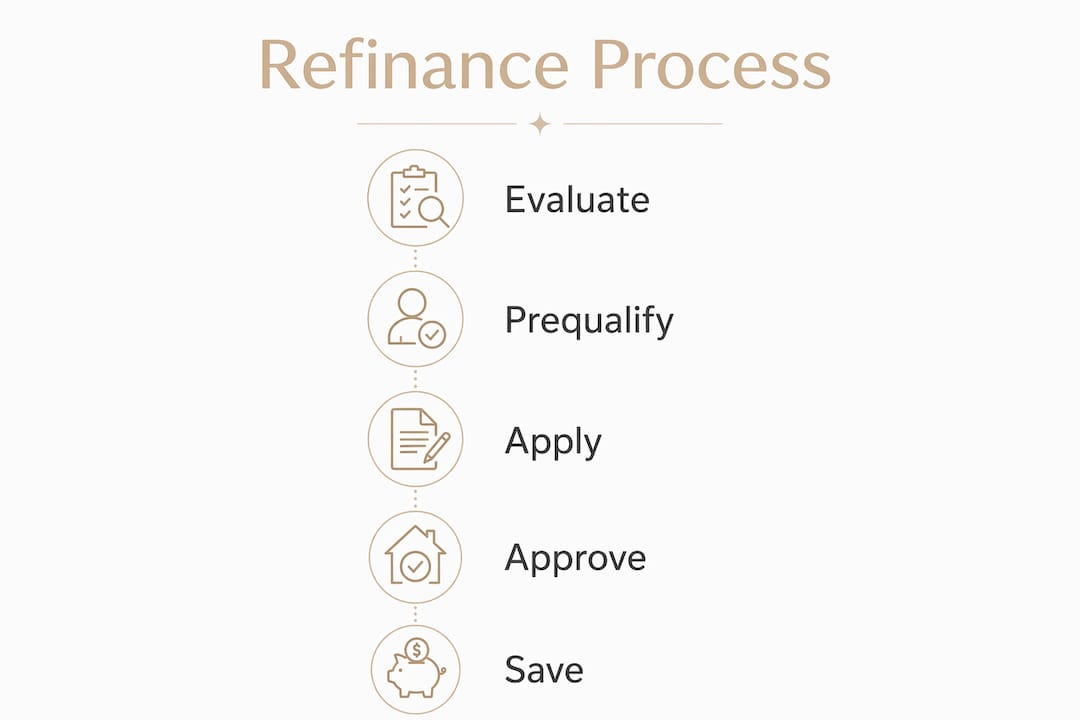
What does the refinancing process look like, step by step?
Timeline and process:
- Prequalify (soft pull): Check rates with 2–3 lenders using soft-pull prequalification. No credit score impact.
- Apply (hard pull): Submit a formal application. Group all hard pulls within a 14-day window so credit bureaus count them as a single inquiry.
- Underwriting: Lender verifies income, vehicle value, and title status. Typically 1–5 business days.
- Payoff request: New lender sends payoff funds to your existing lender.
- Title transfer: Expect 30–60 days for the title to transfer to the new lender, depending on your state.
- Final funding: Your new loan is active. Make payments to the new lender.
Documents you will typically need:
- Current loan statement (account number, payoff amount, lender contact)
- Vehicle title or registration
- Government-issued photo ID
- Proof of income (pay stubs or tax returns)
- Proof of residence (utility bill or bank statement)
- Current auto insurance information
Credit impact: Expect a short-term dip of roughly 5–15 points from the hard inquiry. Most borrowers recover within 90 days, especially with continued on-time payments.
How to use a benchmarking report to negotiate the dealer APR
A benchmark report gives you something most buyers walk in without: documented evidence of what comparable borrowers actually paid. Baywall generates this by matching your credit tier, vehicle, loan amount, and term against real transaction data, then labels your dealer’s quote as great, fair, or high and gives you a specific target APR to negotiate toward.
Practical negotiation steps:
- Run your dealer quote through Baywall’s free basic check before you sign anything.
- Ask the F&I manager for the “buy rate” — the lender’s base rate before any dealer markup.
- Present your benchmark showing the target APR and dollar savings difference.
- Ask the dealer to match the target rate or reduce their markup to close the gap.
- If they won’t move, use the benchmark to apply directly with a credit union or online lender.
| Dimension | Dealer quote | Benchmark target |
|---|---|---|
| APR | 9.5% | 8.0% |
| Monthly payment (48 mo., $25K) | ~$600 | ~$600 |
| Total interest (48 months) | ~$5,100 | ~$4,300 |
| Interest saved | — | ~$800 |
| Required rate drop to break even | — | 1.0+ points |
Pro Tip: If the F&I manager says the rate is “set by the bank,” ask to see the lender’s rate sheet. Dealers are not required to show it, but the request signals you know how dealer reserve works, which often prompts a concession.
How soon can you refinance after buying a car?
The practical minimum is 30–60 days. Applying before the title transfer completes usually results in an automatic rejection, because the new lender cannot place a lien on a title that is still processing. Even lenders that technically allow day-one applications rarely approve them for this reason.
Timing windows to know:
- 30–60 days: Minimum to allow title processing; reduces rejection risk significantly
- 6 months: Enough payment history to demonstrate reliability; some lenders require this
- 12 months: The subprime milestone. For FICO scores in the 550–620 range, 12 months of on-time payments often yields a 30–60 point FICO improvement and can reduce APR by 3–5 points, as confirmed by CarSavr’s research.
- After a Fed rate cut: Monitor rate trackers and prequalify with soft pulls to capture short-term market opportunities
Prequalify early using soft pulls to track what rates you qualify for. Hold off on hard applications until your title is processed and your projected savings justifies refinancing.
Three borrower scenarios with before/after numbers
Scenario A: Prime borrower with a dealer markup
A buyer with a 720 FICO signed at 9.5% through dealer F&I on a $25,000 used car with 48 months remaining. Direct lenders are quoting 7.5% for the same profile. Lifetime interest at 9.5%: ~$5,100. At 7.5%: ~$3,900. Net savings after fees: roughly $1,100. Recommended action: refinance now.
Scenario B: Subprime borrower at the 12-month mark
A buyer started at 590 FICO and 16.0% APR on a $18,000 loan. After 12 months of clean payments, FICO improved to 645. Lenders are now quoting 11.5%. Remaining balance: ~$15,200. Lifetime interest savings over the remaining 36 months: roughly $900. Recommended action: refinance at month 12, then consider a second refinance if FICO crosses 680.
Scenario C: Recently bought and upside-down
A buyer financed $32,000 on a vehicle now worth $27,000 after depreciation. LTV is above 100%. Most lenders will not approve a refinance until the balance drops below the vehicle’s value. Recommended action: make extra principal payments to close the gap, or wait 12–18 months for the balance and depreciation curve to align.
Key Takeaways
Refinancing beats a dealer APR when you drop your rate by at least 1.0 percentage point, save $300 or more in lifetime interest, and have at least 12 months remaining on the loan.
| Point | Details |
|---|---|
| The 1% / $300 rule | Refinance only when the rate drop is ≥1.0 point and lifetime savings clear $300 after fees. |
| Total interest first | Extending your term lowers monthly payments but usually increases total interest paid. |
| Subprime milestone | 12 months of on-time payments can improve FICO by 30–60 points and cut APR by 3–5 points, based on CarSavr data. |
| Wait for title transfer | Apply no sooner than 30–60 days after purchase to avoid automatic rejection. |
| Baywall benchmark | Run your dealer quote through Baywall to get a target APR and dollar savings before you sign. |
Why benchmarking before you sign is usually the safest play
Most buyers walk into the finance office without a single outside data point. The dealer knows the buy rate. The buyer does not. That information gap is where dealer reserve lives, and it costs the average financed buyer real money over the life of the loan. Benchmarking closes that gap before you sign, not after.
The argument for refinancing later is valid, but it has a cost: you pay the marked-up rate for however many months it takes you to act. Refinancing at month six means you overpaid for six months. Refinancing at month twelve means twelve months of avoidable interest. The earlier you have comparable transaction data in hand, the less of that gap you absorb.
Baywall produces APR benchmarks using the same variables lenders actually use: credit tier, vehicle, loan amount, term, and location. The output is not a generic rate range. It is a specific target APR for your deal, with the dollar savings calculated, so you can walk into the F&I office with evidence rather than a hunch.
See what your dealer APR is actually worth
Most buyers overpay on financing not because they lack negotiating skills, but because they lack data. Baywall fixes that. Enter your credit score, vehicle details, loan amount, term, and the dealer’s quoted APR, and Baywall benchmarks it against comparable real transactions. You get a clear verdict: great, fair, or high, plus the exact target rate to push toward and the dollar savings at stake.
The free basic check takes under two minutes. If the numbers show a meaningful gap, the $2.99 detailed report gives you negotiation-ready specifics you can print and bring to the dealership. Run your free check at Baywall now, or go straight to the analyze tool to enter your dealer quote and see where it lands.
Useful sources and further reading
- Experian: When Should I Refinance My Car Loan? Experian’s guidance on credit-score movement, FICO tier thresholds, and how payment history affects refinance eligibility. The primary source for total-interest-first decision rules.
- Bankrate / The Week: Auto Refinance Rate Context Industry rate data and real-world savings figures from Q1 2026, including the average 2.24 percentage point rate reduction and $81 monthly savings reported by Experian.
- Consumer Financial Protection Bureau (CFPB) The CFPB publishes plain-language guides on auto loan rights, the difference between hard and soft credit inquiries, prepayment penalty disclosures, and what lenders are required to tell you. Start here if you have questions about your legal rights during the refinance process.
- CarSavr: When to Refinance an Auto Loan Source for the 1% / 12-month / $300 rule of thumb and the subprime 12-month milestone data.
- 1st Nationwide Mortgage: Refinancing Benefits Background on how refinancing reduces total interest through principal/interest tradeoffs, useful for understanding amortization dynamics across loan types.
This article is general information, not financial or legal advice. Confirm current rates, fees, and eligibility requirements directly with lenders or a qualified financial professional before making any refinancing decision.