Private Party Auto Loan Rates: What You’ll Actually Pay
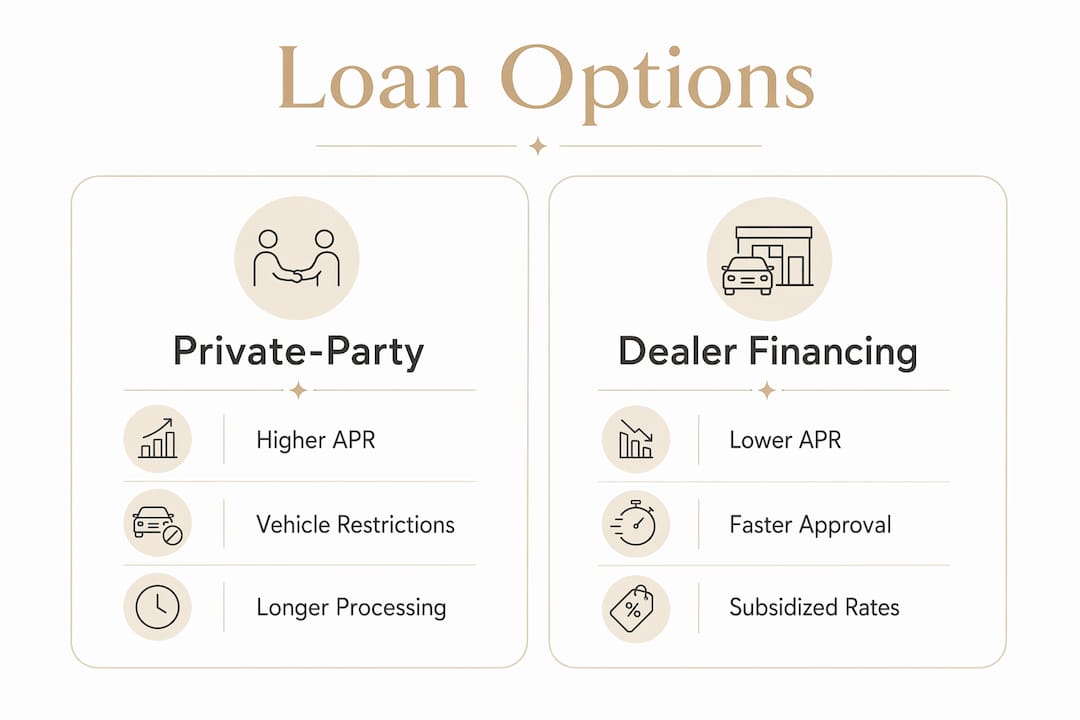
Private party auto loan rates are typically higher than dealer APRs for the same borrower. Lenders view private-party purchases as riskier than dealer transactions because there’s no third-party verification of the vehicle’s condition, no manufacturer warranty, and title transfers are more complex. That said, the gap isn’t fixed, and the right preparation can close it considerably.
Three things to know before you go further:
- Rates are higher on average, but not always. Private-party financing can be competitive with dealer rates for borrowers with strong credit who shop multiple lenders.
- Get preapprovals before you negotiate. Shopping multiple lenders within a short window minimizes credit-score impact and gives you real numbers to compare.
- Check vehicle eligibility first. Some lenders cap model year and mileage on secured loans. If your target car doesn’t qualify, you may be pushed to an unsecured personal loan at a significantly higher rate.
Table of Contents
- How do private-party loans compare to dealer financing and other options?
- Why do lenders charge more for private-party auto loans?
- What determines the APR you’ll actually be offered?
- What are your real alternatives to a private-party loan?
- How to shop, compare, and prepare before you sign
- How to evaluate any loan offer before you commit
- How Baywall helps you benchmark and negotiate your dealer APR
- What does closing a private-party loan actually cost and how long does it take?
- Key Takeaways
- The dealer’s rate is a starting point, not a verdict
- See what your dealer’s APR is actually worth
- Useful sources for further reading
How do private-party loans compare to dealer financing and other options?
The table below maps the four main financing routes by the factors that actually matter at signing.
| Financing Type | Typical APR Range (Relative) | Secured? | Common Terms | Vehicle Restrictions | Best For |
|---|---|---|---|---|---|
| Private-party auto loan | Moderate to high | Yes (vehicle as collateral) | — | Model year and mileage caps common | Buying from an individual; want secured rate |
| Dealer-arranged financing | Low to moderate (can include markup) | Yes | — | Usually none for certified/new inventory | Convenience; manufacturer incentive rates |
| Bank or credit union loan | Low to moderate | Yes | 72 months | Model year and mileage limits vary | Members with good credit; competitive used-car rates |
| Unsecured personal loan | High | No | — | None | Older vehicles that fail secured-loan eligibility |
A few quick notes on when each route makes sense. A private-party loan works when you’ve found a good deal on a private sale and want a secured rate without going through a dealer. Dealer financing is fastest and sometimes cheapest when a manufacturer is subsidizing the rate, but the finance office can mark it up. A credit union or bank loan is often the best rate available if you’re a member and the vehicle qualifies. A personal loan is a fallback when the car is too old or has too many miles for a secured product, though you’ll pay for that flexibility in APR.
Always compare the full APR plus any fees, not just the advertised rate. A lower rate with a $500 origination fee can cost more than a slightly higher rate with no fee.
Why do lenders charge more for private-party auto loans?
The short answer: lenders can’t verify what they’re financing as easily as they can with a dealer sale. That uncertainty gets priced into your rate.
The main underwriting concerns are:
- Condition and inspection uncertainty. A dealer-sold vehicle typically comes with a certified inspection or warranty. A private sale has neither, so the lender has less confidence in the collateral’s value.
- Title and payoff complexity. If the seller still has an active loan, the title isn’t clean. Coordinating a payoff adds steps and risk.
- No dealer warranties or certifications. Lenders know a certified pre-owned car meets a documented standard. A private-sale car might not.
- Higher perceived default risk. Statistically, lenders treat private-party loans as higher-risk products, which means a higher rate floor even for good-credit borrowers.
Vehicle age and mileage policies compound this. Many lenders apply strict model-year and mileage limits to secured private-party products. When a vehicle doesn’t qualify, borrowers get pushed to unsecured options at meaningfully higher APRs.
Pro Tip: Some lenders will accept a third-party inspection report to reduce the perceived risk on a private-sale vehicle. Ask before you apply. A $100 inspection could shave real dollars off your rate.
What determines the APR you’ll actually be offered?
Credit score is the single biggest lever. Borrowers in the top credit tiers consistently receive the lowest available rates; those in the mid-range pay noticeably more. Here’s how the main factors stack up:
- Credit score and profile. Your score determines which rate tier you land in. A difference of 60–80 points can move you into a meaningfully lower bracket.
- Loan term. Longer terms usually carry higher APRs. A 72-month loan costs more per dollar borrowed than a 48-month loan, even before you count the extra months of interest.
- Down payment and loan-to-value. A larger down payment reduces the lender’s exposure and can improve your offered rate.
- Vehicle age and mileage. Older vehicles and high-mileage cars attract higher rates or may not qualify for secured financing at all.
- Loan amount. Very small loan amounts sometimes carry higher rates because the fixed cost of underwriting doesn’t scale down.
- AutoPay enrollment. Some lenders, including LightStream, offer a rate discount of around 0.50 percentage points for AutoPay, but you must opt in before funding. It’s not automatic.
The 14-day shopping window: Multiple hard inquiries for the same loan type within a 14-day window are typically treated as a single inquiry for scoring purposes. Apply to several lenders in a tight cluster, not spread over weeks.
The week before you sign, confirm your co-signer’s availability if you’re using one, and verify the seller’s title status. A surprise lien discovered at closing can delay funding and change your rate.
What are your real alternatives to a private-party loan?
Each alternative has a specific profile where it wins.
Dealer-arranged financing is fast and sometimes subsidized, but the finance manager earns money on the rate spread. You may be quoted 7% when you qualified for 5.5%. Going in with a preapproval in hand changes that dynamic entirely.
Credit union or bank secured loans tend to offer the most competitive rates for qualified borrowers. Credit unions and community banks often run favorable used-car programs for members. If you’re not already a member somewhere, joining before you shop is worth the effort.
Unsecured personal loans carry higher APRs because the vehicle isn’t collateral. They’re the right call when the car is too old or too high-mileage to qualify for a secured product, or when you need to close fast without a lien process.

Paying cash eliminates rate risk entirely and gives you negotiating leverage. If you have the liquidity, it’s worth modeling the opportunity cost against your best available loan rate.
Pro Tip: If you have excellent credit and the car qualifies, a credit union preapproval is often your strongest opening position. Walk into any negotiation with that number already in hand.
How to shop, compare, and prepare before you sign
Follow these steps in order. Skipping any one of them tends to cost money.
- Set your target APR and maximum monthly payment. Know your number before you talk to anyone.
- Get multiple preapprovals within a 14-day window. Apply to at least three lenders. The credit-score impact is the same as one inquiry if you stay within the window.
- Order a vehicle history report and arrange an inspection. A clean history report and inspection result can support your loan application and your price negotiation.
- Confirm title and lien status. Ask the seller directly whether they still owe money on the car. If they do, factor in the payoff coordination timeline.
- Prepare your negotiating evidence. A benchmark report showing the market rate for your credit profile and vehicle is the most concrete tool you can bring to the table.
Documents you’ll typically need:
- Government-issued ID
- Proof of insurance
- Bank routing and account number
- Seller’s vehicle title or payoff information
- Proof of income (recent pay stubs or tax returns)
Pro Tip: When you have a preapproval, you’re effectively a cash buyer. Tell the dealer you have financing arranged and negotiate the vehicle price first, separately from the loan. Dealers often try to bundle these conversations to obscure the markup.
Dealer negotiation checklist:
- Confirm the out-the-door price before discussing financing
- Ask for the buy rate (the rate the lender actually offered the dealer)
- Compare the dealer’s APR to your preapproval
- Ask about prepayment penalties before signing
How to evaluate any loan offer before you commit
Six items to check on every offer:
- APR, not just the interest rate. APR includes fees; the interest rate doesn’t.
- Total interest paid over the life of the loan. Run the full amortization, not just the monthly payment.
- Origination or documentation fees. These add to your real cost even when the rate looks competitive.
- Prepayment penalties. Some lenders charge you for paying off early.
- Loan term. A lower monthly payment over 72 months often costs more total than a higher payment over 48 months.
- AutoPay discount. Confirm whether you need to opt in to receive it.
Here’s a simplified illustration of how term length affects total cost at the same APR:
| Loan Amount | APR | Term | Monthly Payment | Total Interest Paid |
|---|---|---|---|---|
| — | — | 48 months | — | — |
| — | — | 72 months | — | — |
The 72-month loan saves you $130 a month but costs roughly $1,350 more over the life of the loan. That’s a real tradeoff worth making consciously.
How Baywall helps you benchmark and negotiate your dealer APR
Baywall is a rate-benchmarking tool built specifically for this moment: you have a dealer’s quoted APR in front of you and you need to know whether it’s fair.
You enter your credit score, vehicle details, loan amount, term, and the dealer’s quoted rate. Baywall compares that offer against rates from comparable transactions, same credit tier, same loan type, similar vehicle, and returns a clear verdict: great, fair, or high. More importantly, it gives you a target APR to negotiate toward and a dollar-savings estimate so you know exactly what’s at stake.
What the report covers:
- A fair/good/high label on your dealer’s quoted APR
- A target APR based on comparable real transactions
- Dollar savings if you reach the target rate
- Current market pricing for similar vehicles
How to use it at the dealership:
- Enter the dealer’s quote into Baywall’s analyze tool before you sign.
- Review the benchmark report and note your target APR.
- Present the report to the finance manager as evidence, not as a bluff.
- Ask the dealer to match or beat the target rate.
Pro Tip: Dealers respond to data. Saying “I’ve seen rates around X% for my credit profile on comparable vehicles” is far more effective than saying “that seems high.” The Baywall report gives you the specific number to say.
What does closing a private-party loan actually cost and how long does it take?
Expect the process to take anywhere from a few days to over a week, depending on title complexity.
Typical timeline:
- Preapproval: Same day to 48 hours
- Lender paperwork and final approval: 1–3 business days
- Payoff to seller’s lender (if applicable): 3–7 business days; the buyer’s lender sends the payoff directly to the seller’s lienholder, which is the most common cause of delays
- Title transfer and lien filing: Varies by state, typically 1–4 weeks
Common out-of-pocket costs to budget for:
- State sales tax (note: some states calculate this on assessed market value, not the sale price, which can produce a larger tax bill than expected)
- Title transfer fee
- Registration fees
- Lender origination or documentation fees, if any
If the seller still has an active loan, don’t expect instant funding. The formal payoff coordination process takes time, and no lender can shortcut it.
Key Takeaways
Private party auto loan rates are almost always higher than dealer rates for the same borrower, but the right preparation, multiple preapprovals, a clean vehicle, and a benchmark report, can close that gap significantly.
| Point | Details |
|---|---|
| Expect higher APRs on average | Private-party loans carry more lender risk; rates are typically above equivalent dealer-financing offers. |
| Always compare full APR plus fees | The advertised rate excludes origination fees; APR is the only apples-to-apples comparison. |
| Shop within the 14-day window | Multiple hard inquiries for the same loan type in 14 days count as one hit to your credit score. |
| Budget for tax and title surprises | Some states assess sales tax on market value, not sale price; title fees and payoff delays add time and cost. |
| Use Baywall before you sign | Baywall benchmarks your dealer’s quoted APR against comparable transactions and gives you a target rate to negotiate toward. |
The dealer’s rate is a starting point, not a verdict
The finance office is where dealers make a significant portion of their profit. The rate you’re quoted on arrival is rarely the rate the lender actually offered the dealer. There’s usually a spread, and that spread is negotiable.
Most buyers don’t push back because they don’t have a number to push back with. They feel the rate is “about right” or they’re tired from the vehicle negotiation and just want to finish. That’s exactly the moment dealers count on.
The most effective thing you can do is walk in with a preapproval already secured and a benchmark report showing what comparable buyers actually paid. Not what a rate calculator says you should pay in theory, but what real transactions at your credit tier and vehicle type actually closed at. That’s a different conversation entirely.
Dealers are not adversaries, but they are negotiators. Treat the finance conversation the same way you treated the vehicle price: with a specific number, a clear rationale, and the willingness to pause if the offer doesn’t move.
See what your dealer’s APR is actually worth
Most buyers leave money on the table at the finance desk simply because they don’t know what rate they should have gotten. Baywall fixes that with a report built around your specific credit profile, vehicle, loan amount, and term, compared against real transactions, not generic rate tables.
For $2.99, you get a full benchmark report: your target APR, a fair/good/high verdict on the dealer’s quote, your estimated savings in dollars, and comparable vehicle pricing to support your negotiation. There’s also a free basic check if you want to start there.
Run your rate check at Baywall before you sign anything. It takes a few minutes and gives you the one thing that changes the finance conversation: a specific, evidence-backed number.
Useful sources for further reading
- LegalClarity: Car loan for a private sale — Covers rate differences, title complexity, and state sales-tax rules for private-party purchases.
- Experian: What is a private-party auto loan — Explains prequalification, application steps, and how credit quality affects offered rates.
- Capital One: How to get a car loan for a private sale — Practical steps for private-party financing and guidance on shopping multiple lenders.
- Truist: Private party auto loans — Documents vehicle age and mileage restrictions, payoff coordination process, and secured vs. unsecured product differences.
- Space Coast Credit Union: Personal loan vs. auto loan — Compares APRs by term and model year; explains the 14-day inquiry window.
- LightStream: Private-party auto loans — Details on AutoPay discount eligibility and rate ranges for direct-lender private-party products.
- Earnest: Personal loans for car purchases — Explains when an unsecured personal loan makes sense as a fallback for private-sale financing.
This article is general information, not financial or legal advice. Confirm current rates, eligibility rules, and state tax requirements with your lender and state DMV before signing.