Certified Pre-Owned Financing: Get the Best Deal

Manufacturer CPO financing is usually the right starting point for qualified buyers, but only when the captive APR is low enough to offset the vehicle’s price premium. Analysis indicates the average CPO price premium over an identical non-certified used vehicle is approximately $1,200. At a meaningfully lower APR, that premium can disappear into interest savings over a 60-month term. When the captive rate is only marginally better than what a bank or credit union would offer, the premium becomes a straight-up cost.
Before you sign anything, two steps protect you:
- Get pre-approved independently. Consumer Reports recommends pre-approval as the single most effective baseline check before comparing any dealer’s CPO offer.
- Run a Baywall benchmark. Enter your credit score, vehicle, loan amount, term, and the dealer’s quoted rate, and Baywall shows you whether that offer is great, fair, or high relative to comparable real transactions, plus the exact target APR to negotiate toward.
Neither step costs much time. Together, they tell you whether the captive offer is genuinely competitive or just sounds good on paper.
Table of Contents
- What are your financing options for a CPO vehicle?
- How CPO financing works and what comes bundled with the vehicle
- What do current OEM CPO financing offers actually look like?
- Is the captive CPO APR actually a better deal?
- How do you shop, pre-approve, and negotiate CPO financing?
- When should you take the captive offer and when should you walk away?
- Key Takeaways
- What most buyers miss about CPO financing
- Baywall shows you whether the dealer’s CPO rate is actually fair
- Useful sources and further reading
What are your financing options for a CPO vehicle?
Four routes exist when you finance a certified pre-owned purchase. Each has a different rate structure, eligibility logic, and relationship to the CPO warranty.

| Financing path | Typical APR | Common terms | Eligibility limits | Warranty linked? | Where you apply |
|---|---|---|---|---|---|
| Captive OEM finance | Subsidized, often below market | 24–72 months | Excellent credit required for best tier; vehicle age/mileage per OEM program | Yes, CPO warranty bundled | At the dealership |
| Dealer-arranged third-party | Market used-car rate or marked up | — | Varies by lender | No direct link | At the dealership |
| Bank or credit union | Competitive market rate | 24–72 months | Based on your credit profile | No | Pre-approval before dealer visit |
| Online lender | Competitive to slightly above market | — | Based on your credit profile | No | Pre-approval before dealer visit |
Captive OEM finance offers the lowest advertised APRs, but those rates are reserved for buyers with excellent credit and often tied to shorter terms. If you don’t qualify for the top credit tier, the rate climbs fast.
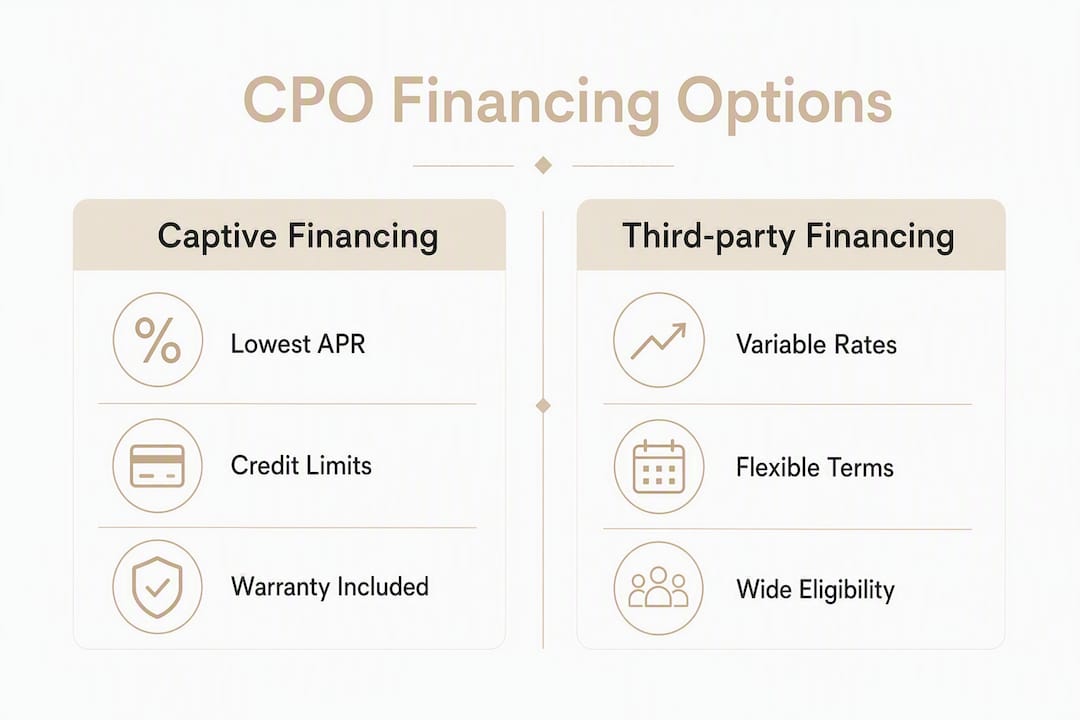
Dealer-arranged third-party financing is the path most buyers fall into by default. The dealer shops your application to several lenders and marks up the rate, keeping the spread as profit. You rarely see the buy rate.
Banks and credit unions are where pre-approval earns its value. A credit union pre-approval in hand gives you a real number to compare against the captive offer, and it signals to the finance manager that you have options.
Online lenders (such as those accessible through platforms that aggregate lender offers) can be competitive, particularly for buyers with good but not excellent credit. Response times are fast, and the pre-approval process is fully digital.
Pro Tip: Negotiate the out-the-door price first, then discuss financing. Dealers sometimes lower the vehicle price when they expect to earn on the financing side. Separating the two conversations keeps both levers visible.
How CPO financing works and what comes bundled with the vehicle
A Certified Pre-Owned vehicle is not just a used car with a sticker. The certification is a structured program, and the financing that comes with it is designed to move that certified inventory, much the way new-car incentives work.
What CPO programs typically bundle:
- A multi-point inspection (commonly 100+ inspection points, though the exact count varies by manufacturer)
- An extended or residual factory warranty, often 1–2 years beyond the original coverage
- Roadside assistance, sometimes for the duration of the CPO warranty
- Vehicle history report access
- In some programs, a limited powertrain warranty that extends to 100,000 miles or beyond
The financing piece is where buyers often misread the offer. Captive lenders subsidize CPO APRs the same way they subsidize new-car rates: the manufacturer absorbs some of the interest cost to accelerate inventory turnover. That subsidy is real, but it comes with conditions.
The lowest advertised rates are generally restricted to borrowers in the top credit tier and often limited to shorter loan terms where the manufacturer’s subsidy is concentrated. Extend the term to 72 months and the rate often steps up, sometimes significantly. Understanding how APR translates to total loan cost across different terms is the single most useful calculation you can run before sitting down with a finance manager.
Statistic to know: The average CPO price premium is approximately $1,200 over a comparable non-certified vehicle. Whether a subsidized captive APR erases that premium depends entirely on the spread between the captive rate and your best outside offer at the same term.
What do current OEM CPO financing offers actually look like?
OEM programs vary considerably in their advertised rates, term structures, and incentive layers. The three programs below represent the range of offers you are likely to encounter.
BMW Financial Services
BMW’s CPO program, administered through BMW Financial Services, publishes special offers on certified pre-owned vehicles that include promotional APRs tied to specific model years and credit qualifications. Offers typically carry end dates and require buyers to take delivery within the promotional window. BMW CPO vehicles must pass a 360-point inspection and carry a 1-year/unlimited-mile BMW Certified Limited Warranty on top of any remaining original coverage. Incentives sometimes include college graduate and loyalty credits that reduce the effective cost of financing.
Nissan (NMAC) / Nissan Certified
Nissan Motors Acceptance Corporation (NMAC) handles financing for Nissan’s certified pre-owned program. NMAC offers promotional CPO rates on select model years, with eligibility tied to credit qualification and specific term lengths. Nissan CPO vehicles undergo a 167-point inspection and carry a 7-year/100,000-mile powertrain warranty from the original sale date, one of the more generous coverage windows in the segment.
Mercedes-Benz Financial Services
Mercedes-Benz Financial Services administers CPO financing for the brand’s Certified Pre-Owned program. Eligible vehicles must be no more than 6 years old and under 75,000 miles. The program includes a 1-year/unlimited-mile Limited Warranty and 24-hour roadside assistance. Promotional APRs are published for qualified buyers and vary by model year and term.
| OEM program | Inspection points | CPO warranty (powertrain) | Notable incentives | Where to apply |
|---|---|---|---|---|
| BMW Financial Services | 360-point | 1-year/unlimited-mile certified warranty | College grad, loyalty credits | BMW dealer |
| Nissan (NMAC) | 167-point | 7-year/100,000-mile from original sale | Varies by promotion | Nissan dealer |
| Mercedes-Benz Financial Services | Multi-point | 1-year/unlimited-mile + roadside | Varies by model year | Mercedes dealer |
Fine print that matters across all OEM programs:
- Promotional APRs require delivery by a specific date and are subject to change without notice.
- The lowest tier rate requires excellent credit; buyers in the “good” credit range typically receive a higher rate.
- Some programs restrict the lowest APRs to terms of 48 months or fewer.
- Incentives like college graduate credits usually require documentation and have their own eligibility windows.
Is the captive CPO APR actually a better deal?
The only honest answer is: it depends on the spread. Here is how to calculate it.
CarScout’s analysis of the financing math shows that a CPO vehicle financed through a captive lender at a meaningfully lower APR can produce a lower total loan cost than a non-CPO vehicle financed at a standard used-car rate, even after accounting for the $1,200 average price premium. The key word is “meaningfully.” A small APR difference on a typical loan term can result in interest savings, but whether this offsets the premium depends on the size of the rate spread and loan details.

Comparison examples over common loan terms illustrate how financing scenarios can affect total cost.
| Scenario | Vehicle price | APR | Monthly payment | Total interest | Total cost |
|---|---|---|---|---|---|
| CPO + captive finance | — | 4.9% | — | — | — |
Some financing scenarios show CPO financing can be advantageous, while others show it adding to total cost depending on rates and premiums. Financing a CPO vehicle through a third-party lender at standard used-car rates can make the premium a straight net cost rather than a value exchange.
Experian’s guidance on used-car loans adds a critical warning: longer terms reduce monthly payments but often increase total interest paid, erasing any APR benefit. If the captive offer requires a 72-month term to hit a payment you can afford, recalculate total interest at both 60 and 72 months before deciding. You can also check current used-car loan benchmarks by credit tier to see what the market is actually paying for your profile.
How do you shop, pre-approve, and negotiate CPO financing?
A structured approach keeps you from leaving money on the table at the dealership.
-
Check your credit score. Know your FICO score before you shop. The difference between a 720 and a 740 can mean a full credit tier at some captive lenders, which changes the advertised rate you actually qualify for.
-
Get pre-approved from a bank or credit union. The FTC recommends getting credit terms in advance so you enter the dealer knowing your APR, term, and maximum loan amount. A credit union pre-approval is particularly useful because credit unions often offer rates below what a dealer’s third-party lender will quote.
-
Request the dealer’s written CPO finance offer. Ask for the APR, term, monthly payment, and total amount financed in writing before you discuss anything else. Do not accept a verbal quote.
-
Run a Baywall benchmark. Enter the dealer’s quoted APR alongside your credit score, vehicle details, loan amount, and term. Baywall compares that offer to real transactions in comparable deals and labels it great, fair, or high. The report also gives you a target APR to negotiate toward and your potential dollar savings.
-
Compare total loan cost, not monthly payment. Multiply the monthly payment by the number of months and add any fees. That is your real cost. Compare it to your pre-approval at the same term.
-
Negotiate the vehicle price first, financing second. Agree on the out-the-door price before the finance manager introduces the loan. Once the price is set, present your pre-approval and ask whether the captive offer beats it on total cost.
-
Ask for the loan amortization schedule. Before signing, request a full amortization table showing every payment, the interest portion, and the remaining balance. This is the only way to verify the total interest figure.
Documents to bring:
- Government-issued photo ID
- Proof of insurance
- Written pre-approval from your bank or credit union
- Trade-in valuations (Carmax, KBB, or dealer appraisal in writing)
- Proof of income if the lender requires it
Red flags to watch for:
- A finance manager who insists you must use dealer financing to receive the CPO warranty (the warranty is tied to the vehicle, not the loan)
- Add-on products (GAP insurance, extended service contracts) bundled into the loan without clear disclosure
- A rate that “requires” a longer term to qualify for the promotional APR
- Conditional incentives that disappear if you bring outside financing
When should you take the captive offer and when should you walk away?
The decision comes down to one comparison: total loan cost at the same term. Here are the rules that hold up in practice.
Take the captive CPO financing when:
- The captive APR is at least 1.5–2 percentage points below your best pre-approval at the same term
- The total loan cost (principal + interest) is lower than your pre-approval scenario, even after the CPO price premium
- You qualify for the top credit tier and the promotional term fits your budget
- The OEM is offering additional incentives (college grad, loyalty, military) that reduce the effective rate further
Use outside financing when:
- Your credit score puts you in a lower tier, and the captive rate is only marginally better than your bank’s offer
- The captive offer requires a longer term (e.g., 72 months) to hit the advertised payment, and total interest exceeds your pre-approval scenario
- The dealer’s third-party rate is higher than your pre-approval and the captive offer is unavailable for your vehicle or credit profile
- You are financing a lender alternative or a vehicle that does not qualify for the OEM’s CPO program
Quick reference for the dealership:
- Calculate total cost at the same term for both offers before deciding
- Never compare a 48-month captive offer to a 72-month bank offer on monthly payment alone
- If the captive rate requires excellent credit and you are borderline, ask for the rate sheet for your actual tier
- Confirm the CPO warranty terms are identical regardless of which lender you choose
Key Takeaways
CPO financing is worth taking when the captive APR is low enough to offset the average $1,200 price premium, but only a total-cost comparison at the same loan term confirms whether the dealer’s offer actually wins.
| Point | Details |
|---|---|
| Pre-approval is non-negotiable | Get a bank or credit union offer before visiting the dealer so you have a real rate to compare. |
| The $1,200 CPO premium is the baseline | A captive APR needs to save more than $1,200 in interest over the loan term to make the CPO price worth it. |
| Total cost beats monthly payment | Always compare total interest paid at the same term, not just the monthly figure. |
| Longer terms can erase APR savings | A lower rate stretched to 72 months often costs more in total interest than a higher rate at 60 months. |
| Baywall benchmarks the dealer’s offer | Run the dealer’s quoted APR through Baywall to get a labeled verdict and a target rate for negotiation. |
What most buyers miss about CPO financing
The most common mistake is treating a low monthly payment as proof of a good deal. A dealer who quotes 4.9% APR on a 72-month term is not necessarily offering a better deal than a credit union at 6.5% on 48 months. The total interest on the longer loan can exceed the shorter one by hundreds of dollars, even with the lower rate. The math is not intuitive, which is exactly why dealers lean on the monthly payment figure.
There is a subtler trap underneath that one. Captive CPO rates are subsidized to move certified inventory, not to give buyers the lowest possible total cost. The manufacturer’s goal is to keep you in the brand ecosystem and off a competitor’s lot. That is a legitimate business interest, and the rate can still be genuinely good. But it means you should treat the captive offer as a starting point for comparison, not a guaranteed win.
Pro Tip: Before you sign, ask the finance manager to print the full loan amortization schedule. Look at the total interest line at the bottom. If it is higher than your pre-approval scenario at the same term, you have your answer.
Baywall shows you whether the dealer’s CPO rate is actually fair
Knowing the captive APR is one thing. Knowing whether it is fair for your specific credit profile, vehicle, loan amount, and location is another. That is the gap Baywall fills.
You enter the dealer’s quoted APR alongside your credit score, vehicle details, loan amount, and term. Baywall benchmarks that offer against real transaction data from comparable deals, labels it great, fair, or high, and delivers a paid report for $2.99 that includes your target APR for negotiation, your potential dollar savings, and current market pricing for similar vehicles. There is also a free basic version to get a first read before you commit.
The report gives you something specific to say to the finance manager: not “I think I can do better,” but “comparable buyers in my credit tier are paying X% on this loan type.” That precision changes the conversation. Run your offer through Baywall’s analyze tool before you sign.
Useful sources and further reading
- How to Finance a Used Car | Consumer Reports — Recommends independent pre-approval as the essential first step before comparing any dealer’s financing offer.
- Can a CPO Car Help You Get a Better Auto Loan Rate? | Cars.com — Explains how captive CPO financing behaves like a new-car incentive and why the lowest rates are restricted to top credit tiers.
- Financing or Leasing a Car | FTC Consumer Advice — Primary government source on pre-approval, APR disclosure, and consumer rights in auto financing.
- CPO Special Offers | BMW USA — Official BMW Financial Services page disclosing current CPO promotional APRs, terms, and eligibility conditions.
- Baywall Rate Benchmarking Tool — Benchmarks a dealer’s quoted APR against real comparable transactions; source for the benchmarking methodology described throughout this article.
- Best Used Car APR by Credit Score | Baywall — Breaks down market APR expectations by credit tier; useful for understanding where your profile sits before negotiating.
This article is general information, not financial or legal advice. Confirm current rates, program terms, and eligibility requirements directly with lenders or a qualified financial professional before making any financing decision.