Best Credit Union Auto Loans: Beat the Dealer’s APR

The smartest move before you sign any dealer financing paperwork is to get a credit-union pre-approval first, then benchmark the dealer’s quoted APR against real market data using a tool like Baywall. That two-step approach consistently puts you in a stronger negotiating position than walking in cold.
Here’s why it works:
- NCUA deposit insurance protects your savings at any federally insured credit union, so your membership account is safe while you shop.
- Nonprofit pricing means credit unions return earnings to members through lower rates and fewer fees rather than to shareholders.
- Pre-approval validity of 60–90 days gives you a firm walk-away number that stays live across multiple dealership visits.
- Le taux médian des prêts automobiles pour véhicules neufs sur 60 mois parmi les caisses de crédit est de 5,250 %, d’après les données du marché ; toutefois, les taux effectifs varient considérablement selon le profil d’emprunteur et l’établissement.
Pro Tip: If your credit union issues an express check or loan draft upon approval, bring it to the dealership. You become a cash-equivalent buyer, which removes the dealer’s ability to mark up a third-party loan rate.
Table of Contents
- Which credit unions offer the best auto loan rates right now?
- How do you compare a dealer APR to a credit-union offer?
- How to get a credit-union auto loan pre-approval
- Who can join a credit union, and what if you don’t qualify?
- How to use your pre-approval to negotiate at the dealership
- Key Takeaways
- Why pre-approval plus benchmarking is the right approach
- Know your dealer’s APR before you sign anything
- Useful sources and official references
Which credit unions offer the best auto loan rates right now?
Five credit unions consistently appear at the top of rate comparisons. Here’s how they stack up on the dimensions that matter most to a buyer who’s about to negotiate.

| Credit Union | Typical APR Range (new, 60 mo.) | Membership / Eligibility | Pre-Approval Speed | Express Check | Terms Supported | Origination / Prepayment Fees |
|---|---|---|---|---|---|---|
| PenFed | 3.39%+ (car buying service) | Open to all (free membership) | Minutes, soft pull | Not publicly listed | — | None listed |
| Navy Federal | — | Military, veterans, DoD civilians, family | Seconds; decisions instant | Yes, express check | — | None listed; rate discount for active duty |
| Alliant CU | Competitive; varies by tier | Open via partner org ($5 donation) | Fast online | Not publicly listed | — | No prepayment penalty |
| Consumers CU | Competitive; varies by tier | Open nationally (small fee) | Fast online | Not publicly listed | — | No prepayment penalty |
| DCU (Digital FCU) | Competitive; varies by tier | Open via partner org | Fast online | Not publicly listed | — | No prepayment penalty |
Quick picks by situation:
- Military or DoD household: Navy Federal is the clear first call. Decisions come in seconds, pre-approvals are valid up to 90 days, and active-duty members get an exclusive rate discount.
- Everyone else: PenFed is open to all Americans with no membership barrier. Its car buying service (powered by TrueCar) unlocks rates starting at 3.39% APR for qualifying buyers.
- No military ties, want a quick open-membership path: Alliant and Consumers CU both allow anyone to join with a small one-time fee or donation, making them accessible fallbacks.
- Tech-forward borrower: DCU’s fully digital application suits buyers who want to handle everything online before stepping into a showroom.
Pro Tip: Advertised “as low as” rates assume excellent credit and often require autopay or direct deposit enrollment. Confirm the exact conditions before comparing that rate to a dealer quote.
How do you compare a dealer APR to a credit-union offer?
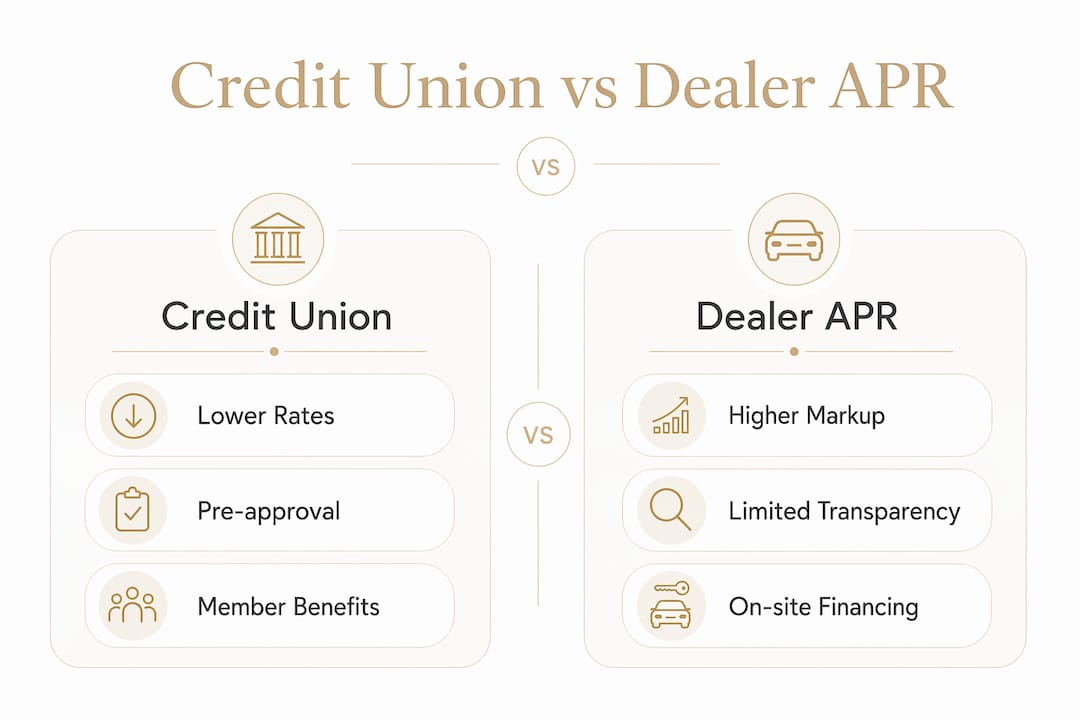
The dealer’s finance office quotes you a rate. That rate is almost never the raw rate the lender approved. It’s usually a marked-up “buy rate,” and the markup is profit for the dealership.
Here’s how to cut through that:
- Confirm you’re comparing APRs, not interest rates. APR includes fees; a bare interest rate does not. Always ask for the APR.
- Match the loan term exactly. A 72-month dealer quote looks cheaper per month than a 60-month credit-union offer but costs more in total interest. Compare same-term to same-term.
- Check for conditional discounts. Some credit unions apply up to a 0.50% discount for direct deposit and a 0.25% loyalty discount. If those conditions aren’t met, your real rate is higher than advertised.
- Faites le calcul en dollars. Sur un prêt de 30 000 $ sur 60 mois : à 5,250 % (le taux médian du marché), vous paierez environ 3 307 $ d’intérêts au total. À 7,25 % (une légère majoration côté concessionnaire), ce montant grimpe à environ 4 635 $. La différence dépasse 1 300 $ — assez pour financer de belles vacances.
- Ask for the buy rate in writing. The dealer’s buy rate is what the lender actually approved. The difference between that and your quoted rate is the markup.
Pro Tip: If the dealer won’t disclose the buy rate, treat your credit-union pre-approval APR as your walk-away number. Any dealer quote above it costs you money.
How to get a credit-union auto loan pre-approval
You can usually get a decision in minutes, and the pre-approval stays valid for 60–90 days, giving you a real negotiation window.
Documents to gather before you apply:
- Government-issued photo ID
- Proof of income (recent pay stubs or tax returns if self-employed)
- Proof of residence (utility bill or lease)
- Vehicle details if refinancing (VIN, mileage, current lender info)
- Membership verification (employer, association, or qualifying donation)
The typical timeline:
- Apply online (5–10 minutes to complete the form).
- Receive a decision — often in seconds for major credit unions like Navy Federal; occasionally a few hours for manual review.
- Get your express check or loan draft — mailed or available for branch pickup.
- Use it at the dealer within the validity window (confirm the exact expiry date in writing).
- Dealer submits paperwork and the credit union funds the loan directly.
Pro Tip: Request the express check even if you’re not sure you’ll use it. Having it in hand signals to the dealer that you have financing locked and don’t need their F&I office.
Who can join a credit union, and what if you don’t qualify?
Credit-union membership rules fall into four common categories:
- Employer or association-based: Your company or a professional group has a credit-union partnership.
- Geographic: You live, work, or worship in a specific county or region.
- Family of members: An immediate family member already belongs.
- Military or federal service: Navy Federal requires active duty, veteran, DoD civilian, or family status.
Quick-join paths when you don’t have a natural tie:
- PenFed is open to all U.S. residents with no special affiliation required.
- Alliant CU allows anyone to join by making a small donation to a partner charity.
- Consumers CU requires a modest one-time membership fee, no employer tie needed.
If none of those work, credit unions’ nonprofit status still gives them a structural rate advantage over most banks, but a community bank with a strong local presence can be a reasonable alternative. Online lenders offer speed and accessibility, though their rates for borrowers with fair credit often run higher than credit-union offers. Adding a creditworthy co-signer can unlock better tiers at any of these lenders.
How to use your pre-approval to negotiate at the dealership
Walk in with your pre-approval document and a benchmarked target APR. That combination is your leverage.
- Show the pre-approval early — not the maximum amount, just the rate. Let the dealer know you have financing.
- State your target APR based on your credit-union offer and market benchmarks. “I’m pre-approved at X%. Can you beat that?”
- Ask for the buy rate and the markup before discussing monthly payments.
- Settle financing before add-ons. Dealers often bundle GAP insurance, extended warranties, and paint protection into the payment to obscure the loan cost.
- Use the expiry window. Tell the dealer your pre-approval expires in 60–90 days and you’re visiting two other dealerships this week.
Red flags to watch for:
- Dealer refuses to provide the buy rate in writing.
- Unexplained fees appear after the rate is agreed.
- Loan term gets extended to lower the monthly payment without reducing the APR.
- Add-ons are presented as required to secure the quoted rate.
Short scripts that work:
- “What’s the buy rate your lender approved, and what’s the markup?”
- “I have a pre-approval at [X]%. I need you to match or beat that before we talk about anything else.”
- “I’ll come back Thursday if you can get closer to my benchmark. I have two other appointments this week.”
Pro Tip: Never reveal your maximum pre-approved amount. Dealers use that ceiling to anchor the vehicle price, not just the loan.
Key Takeaways
Getting a credit-union pre-approval and benchmarking the dealer’s APR against real comparable-loan data is the most reliable way to avoid overpaying on auto financing.
| Point | Details |
|---|---|
| Pre-approve before you shop | Credit-union pre-approvals are valid 60–90 days and give you a firm walk-away APR before you enter a dealership. |
| Le taux médian du marché est votre repère | Le taux médian pour un prêt véhicule neuf sur 60 mois est de 5,250 %. Toute offre de concessionnaire bien supérieure doit être directement remise en question. |
| Express check = cash leverage | Bringing a loan draft to the dealer removes their ability to mark up a third-party rate. |
| Advertised rates have conditions | “As low as” APRs often require autopay or direct deposit; confirm qualifying conditions before comparing. |
| Baywall benchmarks your specific offer | Enter your credit score, vehicle, loan amount, and dealer APR into Baywall to get a labeled verdict and a target rate to negotiate toward. |
Why pre-approval plus benchmarking is the right approach
The conventional advice is to “shop around for rates.” That’s correct but incomplete. Shopping around gives you a range. Benchmarking gives you a verdict on the specific offer in front of you.
A dealer markup of 1–2 percentage points above the buy rate is common and legal. The buyer who walks in with only a credit-union pre-approval knows their floor. The buyer who also benchmarks that offer against what comparable buyers actually paid knows whether the dealer’s counter-offer is reasonable or inflated. Those are two different levels of preparation, and the second one is where the real savings live.
NCUA deposit insurance and published rate tables from lenders like Navy Federal and PenFed provide a credible starting point. But published rates reflect best-case credit profiles. Benchmarking against localized, comparable transaction data is what closes the gap between “what the lender advertises” and “what someone with your exact profile, buying your type of car, in your market, actually paid.”
Know your dealer’s APR before you sign anything
Most buyers spend more time picking a car color than checking whether their loan rate is fair. Baywall exists to fix that. You enter your credit score, vehicle details, loan amount, term, and the dealer’s quoted APR. Baywall benchmarks that offer against real data from comparable transactions and tells you whether it’s great, fair, or high — along with the exact target APR to negotiate toward and your potential dollar savings.
It takes about two minutes. There’s a free basic version to get your bearings, and a $2.99 instant report that gives you the full benchmark, target rate, and comparable vehicle pricing to use at the table. If you’ve already got a credit-union pre-approval in hand, running the dealer’s quote through Baywall is the last step before you sign. Analyze your dealer’s APR now and walk into that finance office knowing exactly what you should pay.
Useful sources and official references
- Navy Federal Credit Union — Auto Loans: Confirms express check availability, 90-day pre-approval validity, and instant-decision processing. Also the source for published “as low as” APRs by term.
- RateAPI — Auto Loan Rate Benchmark: Rate-tracker source for the median 60-month new-vehicle APR (5.250%) and the full observed range (2.500%–25.000%). Use this to anchor any dealer quote against current market data.
- CNBC Select — Best Credit Unions for Car Loans: Editorial source covering nonprofit pricing advantages, membership caveats, and expert guidance on benchmarking dealer quotes against localized loan data.
- PenFed Credit Union — Auto Loans: Lender-published rate table showing new and used APRs by term; confirms open membership and loan amounts up to $150,000.
Rate-tracker sources like RateAPI reflect aggregated market data and are useful for spotting whether a quote is above or below the median. Lender-published pages like Navy Federal and PenFed show the floor rates available to well-qualified borrowers. Both types matter: the tracker tells you where the market sits; the lender page tells you what the best-case looks like for your credit tier.