Does a Soft Pull Auto Loan Prequalify You Without Score Damage?

A soft pull auto loan prequalification does not affect your credit score. When you prequalify with a lender like Bank of America, Capital One Auto Navigator, or PenFed, the soft inquiry stays invisible to other lenders and never touches your FICO score.
Here’s what that actually means for you:
- The rate and loan amount you see are estimates, not a locked-in offer.
- No hard inquiry shows up on your credit report, so other lenders never see you’ve been shopping.
- You can prequalify with several lenders the same afternoon and compare numbers side by side, risk free.
“Pre-qualification typically uses a soft credit inquiry and provides rate estimates based on limited information, while pre-approval uses a hard inquiry and independent verification,” according to NerdWallet’s breakdown of the two processes.
Pro Tip: Before you type in your Social Security number on any prequalification form, look for the words “soft pull” or “no impact to your credit score” on the page. If you don’t see that language, call the lender and ask directly.
Key Takeaways
Prequalifying for an auto loan through a soft pull lets you compare real rate estimates from multiple lenders without any impact to your credit score.
| Point | Details |
|---|---|
| Soft pulls carry no score impact | Prequalification with lenders like Bank of America or PenFed never affects your FICO score. |
| Confirm inquiry type first | Always ask a lender directly whether prequalification uses a soft or hard pull before sharing data. |
| Estimates aren’t guarantees | Final APR and loan amount depend on verification and usually require a hard pull to finalize. |
| Shop fast, apply once | Prequalify with several lenders, then submit only one formal application within a short window. |
| Verify the dealer’s number | Run the dealer’s quoted APR through Baywall to confirm it’s fair before you sign. |
Table of Contents
- Soft Pull vs. Hard Pull: Why the Difference Matters for Your Auto Loan
- How Does Auto Loan Prequalification Actually Work?
- What Prequalification Gives You, and What It Doesn’t
- How to Shop Multiple Lenders Without Hurting Your Credit
- What Credit Scoring Research Says About Multiple Auto Inquiries
- What Information Do Lenders See During a Soft Pull?
- Do Banks, Credit Unions, and Online Lenders Handle Soft Pulls Differently?
- Common Misconceptions About Soft Pulls and Auto Loans
- How to Use Prequalification Numbers When Budgeting for a Car
- Do Soft Pulls Affect Future Loan Decisions Even Without Hurting Your Score?
- A Recent Car Buyer’s Experience with Soft-Pull Shopping
- Check Your Dealer’s Offer Against Real Market Data
- Frequently Asked Questions
- Sources
Soft Pull vs. Hard Pull: Why the Difference Matters for Your Auto Loan
A soft inquiry (also called a soft pull) is a background credit check that only you can see on your own report. Lenders use it for prequalification, promotional offers, and background verification. It never moves your credit score, no matter how many you rack up.
A hard inquiry (hard pull) is different. It happens when you submit a full application and authorize a lender to pull your complete credit file for underwriting. Hard pulls are visible to every future lender who checks your report, and they typically knock 5 to 10 points off your FICO score, though the dip is usually temporary.
| Feature | Soft Pull | Hard Pull |
|---|---|---|
| Visible to other lenders | No | Yes |
| Credit score impact | None | Typically 5 to 10 points |
| When it’s used | Prequalification, offers | Formal loan application |
| How long it stays on file | Doesn’t appear to others | Up to 2 years |
Knowing which type a lender uses before you hit “submit” is the single most useful habit you can build as an auto loan shopper.
How Does Auto Loan Prequalification Actually Work?
Prequalification follows a predictable pattern, whether you’re doing it through a national bank, a credit union, or an online lender.
- You submit basic information. Name, address, estimated income, desired loan amount, and the vehicle type you’re considering.
- The lender runs a soft inquiry. This checks your general creditworthiness without a full credit pull.
- You get an estimated rate and loan amount. This is based on your credit tier and the limited data you provided.
- You shop that estimate against other offers. Nothing is locked in yet.
Lenders typically ask for:
- Estimated annual income or income range
- Rough monthly debt obligations
- Desired loan amount or vehicle price
- Vehicle type (new, used, or specific make/model)
Picture a shopper eyeing a used SUV. She prequalifies with Bank of America’s auto prequalification tool, Capital One Auto Navigator, and her local credit union, all in one evening. Three soft pulls later, she has three estimated APRs, ranging from 6.9% to 8.4%, and zero impact on her credit score.
What Prequalification Gives You, and What It Doesn’t
Prequalification is a planning tool, not a promise. It’s genuinely useful, but only if you understand its limits going in.
What you get:
- A realistic sense of your likely APR range based on your credit tier.
- An estimated monthly payment so you can budget before you visit a dealer.
- Leverage: knowing your numbers ahead of time changes how a negotiation goes.
What you don’t get: a guarantee. Prequalification estimates rely on self-reported information. Connexus Credit Union notes that the quoted APR and loan amount can shift once a lender verifies your income, employment, and full credit file, a step that usually requires a hard pull.
On timing and cost, prequalification is about as low friction as financial tools get. Most lenders return results in a matter of minutes online, and the process is almost always free. A handful of niche lenders may charge a nominal application fee later in the process, but the prequalification step itself rarely costs anything.
How to Shop Multiple Lenders Without Hurting Your Credit
Comparing rates across lenders is exactly how you find the best deal, and you can do it aggressively without any credit consequence if you follow a simple sequence.
- Prequalify with 3 to 5 lenders using soft pulls. Mix bank, credit union, and online lender types to get a realistic spread of offers.
- Hold off on formal applications until you’ve picked a favorite. That’s when a hard pull actually happens.
- Submit all formal applications within a short window. Credit scoring models generally treat multiple auto loan hard inquiries made in a short period as a single inquiry, so shopping fast protects your score even at the hard-pull stage.
- Submit only one hard application to the lender you actually choose. There’s no reason to trigger more than one hard pull once you’ve compared soft-pull estimates.
Pro Tip: Ask this exact question before submitting any information: “Does prequalifying with you use a soft or hard credit pull?” A lender that hesitates or can’t answer clearly is a signal to slow down and read the fine print.
A useful script for online chat widgets: “I’m comparing rates before applying. Will checking my rate here affect my credit score?” Legitimate lenders answer this instantly, because they want cautious shoppers to feel safe prequalifying. If a representative dodges the question or says “it depends,” ask for it in writing before you proceed.
The rate-shopping window isn’t infinite, and scoring models vary slightly on how many days count as “the same search.” Treating your shopping spree as a single, focused week rather than a slow drip over a month keeps you safely inside that protection.
What Credit Scoring Research Says About Multiple Auto Inquiries
The data on this is more forgiving than most shoppers assume. Hard inquiries from multiple auto lenders within a short shopping period are typically bundled and treated as one inquiry for scoring purposes, a design built specifically so that rate shopping doesn’t punish you for being a smart consumer.
“Shopping for an auto loan generally has little to no long-term impact on your credit score if you keep applications within a short shopping window,” the Consumer Financial Protection Bureau explains.
A single hard pull typically costs 5 to 10 FICO points, and that dip is usually temporary, tending to recover within a few months as long as you make on-time payments. Soft pulls, meanwhile, never enter the equation at all. That asymmetry is exactly why prequalification exists as a separate, lower-stakes step before the real application.
What Information Do Lenders See During a Soft Pull?
A soft pull gives lenders a limited but real look at your credit profile. They typically see your credit score range, general payment history, existing account types, and total outstanding debt, enough to sort you into a rough credit tier and generate an estimated rate.

What they don’t get is a full underwriting picture. Soft pulls generally skip the granular detail a hard pull provides, like exact account-by-account payment timelines or the specific inquiry history other lenders would see. That’s part of why the estimate you receive from a soft pull can shift once a lender runs a complete file.
Crucially, this information stays private to that transaction. Other lenders checking your credit report later won’t see that Bank of America or PenFed peeked at your file for a prequalification. Your own credit report will show it if you review your file through a service like AnnualCreditReport.com, but it’s filed separately from the inquiries that affect your score, usually under a section labeled “soft inquiries” or “promotional inquiries.”
This distinction matters most when you’re actively comparing several offers. You can let five or six lenders look at limited credit data without a single one of them, or any future lender, ever knowing the others existed. That privacy is precisely what makes aggressive rate shopping through soft pulls a smart, safe habit rather than a credit risk.
Do Banks, Credit Unions, and Online Lenders Handle Soft Pulls Differently?
The core mechanics of a soft pull stay the same everywhere, but the experience around it varies by lender type.
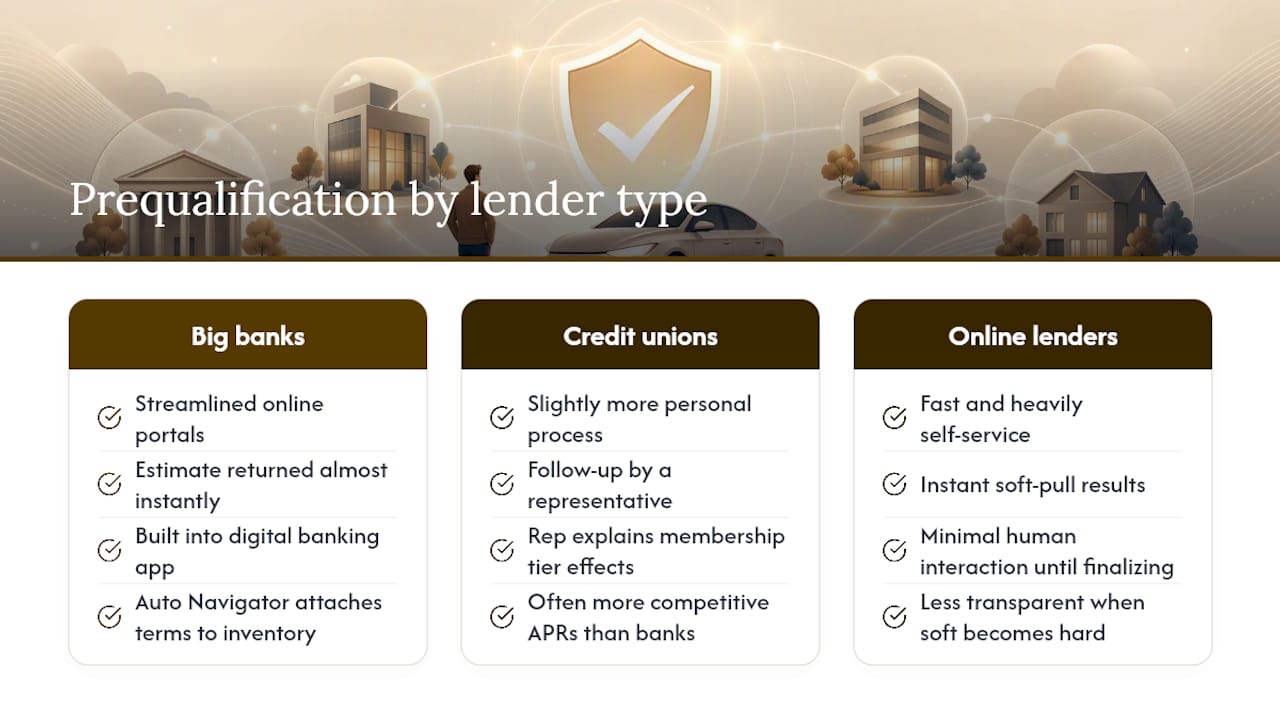
Large banks like Bank of America run prequalification through streamlined online portals that return an estimate almost instantly, often built into the broader digital banking app. Capital One’s Auto Navigator goes a step further, letting you prequalify and then browse actual dealer inventory with your estimated terms already attached, so you can shop cars and financing at the same time.
Credit unions, including PenFed, tend to fold prequalification into a slightly more personal process. You might still apply online, but PenFed and similar member institutions often follow up with a representative who can walk through your estimate and explain how membership tier or existing accounts affect your rate. Credit unions frequently offer more competitive APRs than banks for the same credit tier, which makes their prequalification numbers worth collecting even if the process feels slightly less automated.
Online-only lenders sit somewhere in between. They’re usually fast and heavily self-service, with instant soft-pull results and minimal human interaction until you’re ready to finalize. The tradeoff is that some online lenders are less transparent about exactly when a soft pull becomes a hard one, which is exactly why confirming the inquiry type in writing matters more with this group than with an established bank or credit union.
Common Misconceptions About Soft Pulls and Auto Loans
The biggest misconception is that prequalifying “locks you in” to a lender or a rate. It doesn’t. A soft pull estimate is non-binding on both sides. You can prequalify with five lenders and walk away from all of them with zero obligation and zero credit consequence.
A second misconception: some shoppers assume any online rate check is automatically a soft pull. That’s not guaranteed. Terminology gets used loosely across the industry, and NerdWallet specifically warns that “pre-qualification” and “pre-approval” are sometimes used interchangeably even though they involve different inquiry types. Always confirm directly rather than assuming based on the word a lender’s marketing page uses.
A third risk worth flagging: entering personal information into an unfamiliar lender’s prequalification form without verifying who they are. Before sharing sensitive data with a lender you haven’t heard of, check their registration through NMLS Consumer Access, a free lookup tool that confirms licensing.
Finally, some shoppers assume a great prequalification estimate means the dealer’s financing offer will automatically match it. It won’t necessarily. Dealer financing often includes markup the lender’s own prequalification number never accounted for, which is exactly the gap tools built for comparing dealer quotes against real market data are designed to catch.
How to Use Prequalification Numbers When Budgeting for a Car
Treat your prequalification estimate as a ceiling, not a target. If three lenders return APRs between 7.1% and 8.9% for your credit tier, budget your monthly payment around the higher end of that range, not the lowest number you saw. That gives you a cushion if your actual approved rate lands higher after verification.
Use the estimated loan amount to work backward into a realistic price range for the vehicle itself, factoring in your down payment and any trade-in value. If a lender estimates you can borrow $28,000 comfortably, that number should shape which vehicles you even bother test driving, not just which financing offer you accept later.
It’s also worth running your estimated numbers against current market benchmarks for the vehicle type you want, since a “good” APR for a used sedan looks different from a good APR for an SUV or a luxury trim. Your credit tier sets the baseline, but vehicle type and loan term both shift the number meaningfully.
Finally, hold your prequalification results loosely once you’re at the dealership. A dealer’s finance office will often present its own number first, hoping you won’t compare it to anything. Having two or three soft-pull estimates in your back pocket, along with a clear read on APR versus interest rate, turns that moment from a guessing game into a negotiation you control.
Do Soft Pulls Affect Future Loan Decisions Even Without Hurting Your Score?
A soft pull won’t touch your score, but that doesn’t mean it’s entirely invisible in your financial life. The lender that ran it retains a record on their end, and some institutions use that history for future marketing or preapproved offers, which is why you might see a promotional letter from a bank you soft-pulled with months earlier.
Soft pulls also shape how efficiently you move through the rest of the buying process. A shopper who prequalified with several lenders walks into a dealership with real numbers, which changes the dealer’s incentive to negotiate. A shopper with no prequalification data has no anchor point and is more likely to accept whatever rate the finance office quotes first.
There’s a subtler effect too: the estimates you collect from soft pulls train you to recognize what a fair offer actually looks like for your credit tier. That awareness carries forward into future purchases, refinancing decisions, and even how you evaluate other credit products down the line. In that sense, soft pulls do something real even though they never move a single point on your credit report. They build the pricing literacy that makes every future negotiation, on a car loan or otherwise, a little sharper.
A Recent Car Buyer’s Experience with Soft-Pull Shopping
I prequalified with two banks and my credit union before ever setting foot on a lot, comparing three soft-pull estimates in an evening. Walking in with a number already in hand, I asked the finance manager point blank whether their in-house offer would involve a hard pull, and confirmed it before signing anything. That one question saved me from an unexpected inquiry I hadn’t budgeted for.
Check Your Dealer’s Offer Against Real Market Data
Prequalification tells you what a lender thinks you might qualify for. It doesn’t tell you whether the APR a dealer actually quotes you once you’re sitting in the finance office is fair for your credit tier and vehicle. That’s a different question, and it’s the one that costs buyers real money when they get it wrong.
Baywall fills that specific gap. Once you’ve gathered a few soft-pull estimates and you’re ready to negotiate, run the dealer’s quoted APR through Baywall’s benchmarking report. It compares your offer against real transactions from buyers with a similar credit tier, vehicle, and loan term, then labels it great, fair, or high, and hands you a specific target rate to push toward along with your potential dollar savings. Think of prequalification as gathering your ammunition and Baywall as making sure you aim it correctly. Head to Baywall before you sign anything at the dealership.
Frequently Asked Questions
Does prequalifying for an auto loan hurt my credit score? No. Prequalification almost always uses a soft inquiry, which never affects your FICO score, regardless of how many lenders you check with.
How is prequalification different from preapproval? Prequalification uses a soft pull and limited, self-reported information to give you an estimate. Preapproval uses a hard pull and verified documents to produce a firmer offer.
Can I prequalify with more than one lender? Yes, and you should. Prequalifying with several lenders, including a mix of banks, credit unions, and online lenders, gives you a realistic range of rates to compare before you commit to one.
When does a hard pull happen in the auto loan process? A hard pull typically happens when you submit a formal application, whether that’s directly to your chosen lender or through the dealer’s finance office at signing.
Is prequalification free? Yes, in almost all cases. Most lenders offer prequalification online at no cost, and results usually arrive within minutes.
This article is general information, not a substitute for advice from a qualified financial advisor. Consult a qualified financial professional about your own circumstances before acting on anything here.
Sources
- Getting Auto Loan Preapproval or Pre-Qualification - NerdWallet
- How will shopping for an auto loan affect my credit? - CFPB
- Auto Loan Pre-Qualification and Pre-Approval: What’s The Difference? - Connexus Credit Union