What APR Should an 800 Credit Score Get on a Car Loan?

If your credit score sits around 800, you’re in line for the best auto loan pricing lenders offer. As of Q1 2026, super-prime borrowers (781 and above) averaged 4.55% APR on new car loans and 6.30% APR on used car loans, according to Experian’s latest data. That’s the benchmark. In practice, competitive offers for 800-score buyers usually land in a range around those averages, sometimes lower for new cars with promotional financing, sometimes a bit higher on used vehicles depending on the lender and loan term.
Your actual rate still depends on more than your score. Loan term, down payment, debt-to-income ratio, and which lender you’re comparing against all move the number.
- New car floor to typical: roughly 3.9% to 5.5% for most 800-score buyers
- Used car floor to typical: roughly 5.5% to 7.0%, with wider lender variance
- Promotional 0% APR deals exist for new cars but usually require manufacturer financing and specific model years
Key Takeaways
An 800 credit score qualifies you for super-prime auto loan pricing, but the exact APR you get still depends on lender, term, and negotiation, not your score alone.
| Point | Details |
|---|---|
| Know the benchmark | Super-prime buyers averaged 4.55% APR on new cars and 6.30% on used cars in Q1 2026. |
| Watch the tier cutoff | Crossing 781 can unlock meaningfully better pricing and promotional 0% financing offers. |
| Shorter terms save more | A 48 to 60 month term usually cuts total interest sharply compared to 72 or 84 months. |
| Document competing offers | Written prequalifications from multiple lenders give you real leverage against dealer markup. |
| Verify your specific quote | Baywall benchmarks your dealer’s exact APR offer against comparable transactions and gives you a target rate and savings estimate. |
This article is general information, not a substitute for advice from a qualified financial advisor. Consult a qualified financial professional about your own circumstances before acting on anything here.
Table of Contents
- Current Benchmarks and Where Auto Loan Rates Are Headed
- What Actually Moves Your Rate Beyond Your Score
- What an 800 Score Actually Means to Lenders
- How to Shop and Negotiate Your Way to the Lowest APR
- Real Numbers: What a Lower APR Saves You
- Checking Whether Your Dealer’s Quote Is Actually Fair
- Sources
Current Benchmarks and Where Auto Loan Rates Are Headed
The Experian numbers aren’t just averages pulled from thin air. They come from tracking millions of financed vehicle transactions across the credit spectrum, then segmenting by tier. Super-prime is the top tier, and 4.55% for new and 6.30% for used represent what buyers with scores comparable to yours actually paid, not a theoretical best case.
Super-prime borrowers averaged 4.55% APR on new cars and 6.30% on used cars in Q1 2026 — roughly two full points below prime-tier buyers on new car loans.
| Credit tier | New car APR | Used car APR |
|---|---|---|
| Super-prime (781+) | 4.55% | 6.30% |
| Overall market average | 6.30% | Higher, varies by lender |
Rates have been easing slightly compared to the sharper hikes seen in prior years, largely tracking Treasury yield movement and lender competition for the best-qualified borrowers. When the Federal Reserve holds or trims short-term rates, auto lenders tend to follow with a lag of a few months. NerdWallet’s tracking of average rates by credit score shows a similar pattern: super-prime buyers consistently sit several points below the broader market average, and that gap holds up whether the overall rate environment is rising or falling.
Used car loans carry a persistent premium over new car loans, even at the top credit tier. Part of that comes from vehicle age and depreciation risk. A lender financing a three-year-old sedan is pricing in more uncertainty about resale value than one financing a car straight off the lot, and that shows up in your APR regardless of how clean your credit file looks.

One thing worth understanding: these are averages, not guarantees. A dealer quoting you 7.2% on a used car when the super-prime average is 6.30% isn’t necessarily lying about market conditions. They might just be marking up the rate for profit, which happens more often than most buyers realize.
What Actually Moves Your Rate Beyond Your Score
Your 800 credit score opens the door to the best pricing tier, but it doesn’t set the exact number. Lenders build pricing models around several other inputs, and understanding them is what separates a buyer who accepts the first offer from one who negotiates it down.
- Debt-to-income ratio (DTI): Lenders want to see your total monthly debt obligations, including the new car payment, stay well under 40% of gross income. A high DTI can push your rate up even with a great score.
- Loan-to-value ratio (LTV): Financing 100% or more of a vehicle’s value (rolling in negative equity, for instance) signals more risk than a loan backed by a solid down payment. Learn more about how loan-to-value ratios affect auto loan pricing.
- Loan term: Stretching to 72 or 84 months often comes with a small rate bump compared to 48 or 60 months, on top of the extra interest that accrues from a longer payoff schedule.
- Vehicle age and mileage: Used cars over five years old, or with high mileage, often get treated as higher risk regardless of your credit profile.
- Recent credit activity: A late payment or new account opened in the past few months can nudge your effective rate even if your score technically stays in the 800 range.
Lender margin also plays a bigger role than most buyers expect. Two lenders can pull the same credit file and offer meaningfully different APRs because their internal profit targets and risk models differ. Dealerships often mark up the wholesale rate a lender gives them before quoting it to you, sometimes by a full percentage point or more.
Pro Tip: Shop your loan within a 14-day window. Multiple auto loan inquiries in that period typically count as a single inquiry on your credit report, so you can compare several lenders without the hard pulls stacking up and dinging your score.
What an 800 Score Actually Means to Lenders
An 800 FICO score puts you in the super-prime tier, generally defined as 781 and above. Most adults carry a score of 800 or higher](https://www.experian.com/blogs/ask-experian/how-many-americans-have-800-credit-score/), so you’re already ahead of most of the financing pool before a lender even runs the numbers.
Tier cutoffs matter because pricing doesn’t move in a smooth line as your score climbs. It moves in steps.
- Prime tier (661 to 780) often faces noticeably higher APRs than super-prime, even for scores just a few points below 781
- Crossing from 780 to 781 can trigger access to a materially better rate table, according to industry credit-tier breakdowns
- Promotional 0% APR offers from manufacturer finance arms are almost always reserved for the super-prime tier, per Experian’s explainer on auto loan financing
That non-linear jump is why two buyers with scores of 779 and 800 can see very different loan offers, even though both would call their credit “excellent.”
How to Shop and Negotiate Your Way to the Lowest APR
Having an 800 score gets you access to the best rate table. Getting the best rate on that table takes a bit of legwork.
- Prequalify with multiple lenders using soft-pull tools. Online lenders and credit unions typically let you check your rate without a hard inquiry, so gather two or three written offers before you set foot in a dealership.
- Compare dealer financing against banks and credit unions directly. Dealers often mark up the rate a lender quotes them. A credit union offer in hand gives you a real number to hold the dealer against.
- Use competing offers as leverage. Tell the finance manager you have a written prequalification at a lower rate and ask them to beat it. Many dealers will match or undercut a documented competing offer rather than lose the sale.
- Ask about fees before you compare APRs. An origination fee or documentation fee can offset a slightly lower rate. Favor lenders with no origination fee when the APRs are close.
- Choose the shortest term you can comfortably afford. A 48 or 60-month loan usually carries a lower APR than 72 or 84 months, and it slashes total interest paid over the life of the loan.
- Time your purchase around promotional financing windows. Manufacturer 0% APR deals cluster around model year changeovers and major sales events, and they’re typically only available to super-prime buyers.
Pro Tip: Get your prequalification letter in writing, not just a verbal quote over the phone. A documented offer is what actually moves a finance manager, because they know you can walk away and use it elsewhere.
Real Numbers: What a Lower APR Saves You
Small APR differences turn into real money once you stretch them across a full loan term. Here’s what that looks like using Experian’s super-prime benchmarks against a slightly higher, still-common dealer markup.
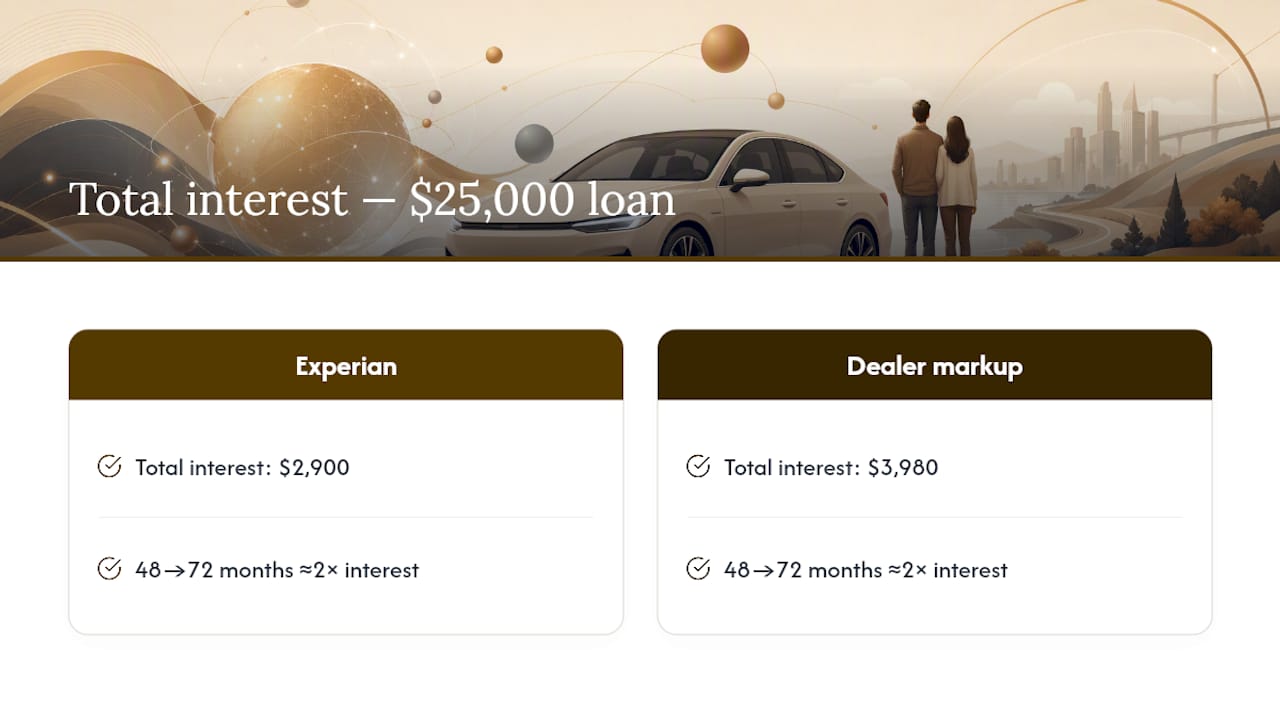
That gap between $2,900 and $3,980 in total interest on the exact same $25,000 loan is real money for a similar-sized used car or a weekend trip you’d otherwise skip. Term length matters just as much as the rate itself. Stretching a $25,000 loan from 48 to 72 months at the same APR roughly doubles the total interest you’ll pay, even though your monthly payment drops. If you can afford the higher payment, the shorter term almost always wins on total cost, which is a point worth checking against your own numbers using how simple interest accrues on an auto loan.
Checking Whether Your Dealer’s Quote Is Actually Fair
Knowing the super-prime average is useful, but it doesn’t tell you whether the specific number your dealer just quoted is fair for your exact loan. That’s the gap Baywall closes.
You enter your credit score, the vehicle, your loan amount, the term, and the APR the dealer quoted. Baywall benchmarks that offer against real transactions from buyers in the same credit tier, financing similar vehicles, on similar terms.
- Inputs: credit score, vehicle details, loan amount, term, dealer’s quoted APR
- Outputs: a target APR to negotiate toward, a label (great, fair, or high), and your estimated dollar savings if you push back
- Speed: you get a specific number in minutes, not a vague sense of “that sounds okay”
For an 800-score buyer, this matters because you have the most room to be overcharged without noticing. A dealer marking up your rate by a point still sounds “good” if you don’t know the real super-prime average for your exact loan structure.
The priority order for 800-score borrowers
If you take one thing from all of this, prioritize documentation over assumptions. Walk in with written prequalification offers, pick the shortest term your budget allows, and favor lenders without origination fees over a marginally lower headline rate. Negotiate every quote against those written offers rather than accepting the dealer’s first number. Your score gets you a seat at the best table, but it won’t negotiate for you, and that’s the part most 800-score buyers leave on the table without realizing it.
— Baywall
Find Out If Your Dealer’s Rate Is Actually Competitive
Baywall exists for exactly the moment described above: your dealer just quoted you an APR, and you want to know if it’s genuinely competitive or padded with markup. Enter your credit score, vehicle, loan amount, term, and the quoted rate, and Baywall returns a target APR, a clear great/fair/high label, and your estimated dollar savings if you negotiate. You can run a free check in a few minutes or purchase the instant $2.99 report for the full breakdown, including comparable vehicle pricing to strengthen your case at the dealership. Check your car loan rate before you sign anything.
Sources
- Average Car Loan Interest Rates by Credit Score — Experian
- How your credit score maps to auto loan rates — CarSavr