Is a 5% APR Car Loan Good in 2026? What Buyers Should Know

A 5% APR is a solid deal for a used car and a mediocre one for a new car, depending entirely on your credit tier. If your credit score sits above 720, you should be seeing new-car offers closer to 4% or even in the high 3s, which makes 5% overpriced. If you’re financing a used vehicle or your score sits in the mid-600s to low-700s, 5% is often competitive or even a good outcome.
Three things flip this verdict:
- Credit tier. Superprime borrowers (720+) can push well under 5% on new cars; near-prime borrowers may see 8% to 12% regardless of what they do.
- New vs. used. Used-car APRs typically run 0.5 to 1.5 percentage points higher than new-car rates for the same borrower.
- Loan term. Stretching to 72 or 84 months usually raises the APR a lender quotes, on top of adding years of interest.
Before you sign anything, run your exact numbers, credit score, vehicle, and term, through a payment calculator or a rate benchmark so you know whether 5% is a win or a number worth pushing back on.
TL;DR:
- Borrowers with credit scores above 720 should aim for rates below 4 percent on new cars, making 5 percent generally overpriced for them.
- Used-car APRs are usually 0.5 to 1.5 percentage points higher than new-car rates for the same borrower, increasing total borrowing costs.
- Opting for longer loan terms of 72 or 84 months typically raises the APR and significantly increases total interest paid over the life of the loan.
- The quoted APR often includes fees like origination, documentation, and financed add-ons, which can make the actual cost higher than the interest rate alone.
- Benchmark your dealer’s quote against real market data using tools like Baywall to identify fair rates and negotiate better terms before signing.
Table of Contents
- What a 5% APR Car Loan Actually Costs You
- Where Does 5% Land Compared to Current U.S. Auto Loan Rates?
- What Determines the APR a Lender Offers You
- How to Get Your Car Loan Under 5% APR
- How Baywall Tells You If Your 5% Offer Is Actually Fair
- APR vs. Simple Interest: What You’re Actually Paying For
- Why APR Compounds Over the Life of Your Loan
- APR and Interest Rate Aren’t Interchangeable Terms
- What Fees Get Folded Into Your Car Loan’s APR
- Don’t Let APR Tunnel Vision Cost You Elsewhere
- Rate Dispersion Is Wider Than It’s Been in Years
- Get Your Dealer’s Rate Checked Before You Sign
- Key Takeaways
- Sources
What a 5% APR Car Loan Actually Costs You
Numbers make this real faster than percentages do. Take a $40,000 new car loan. That’s a swing of almost $3,850 in total cost between the best and worst case on the exact same loan.
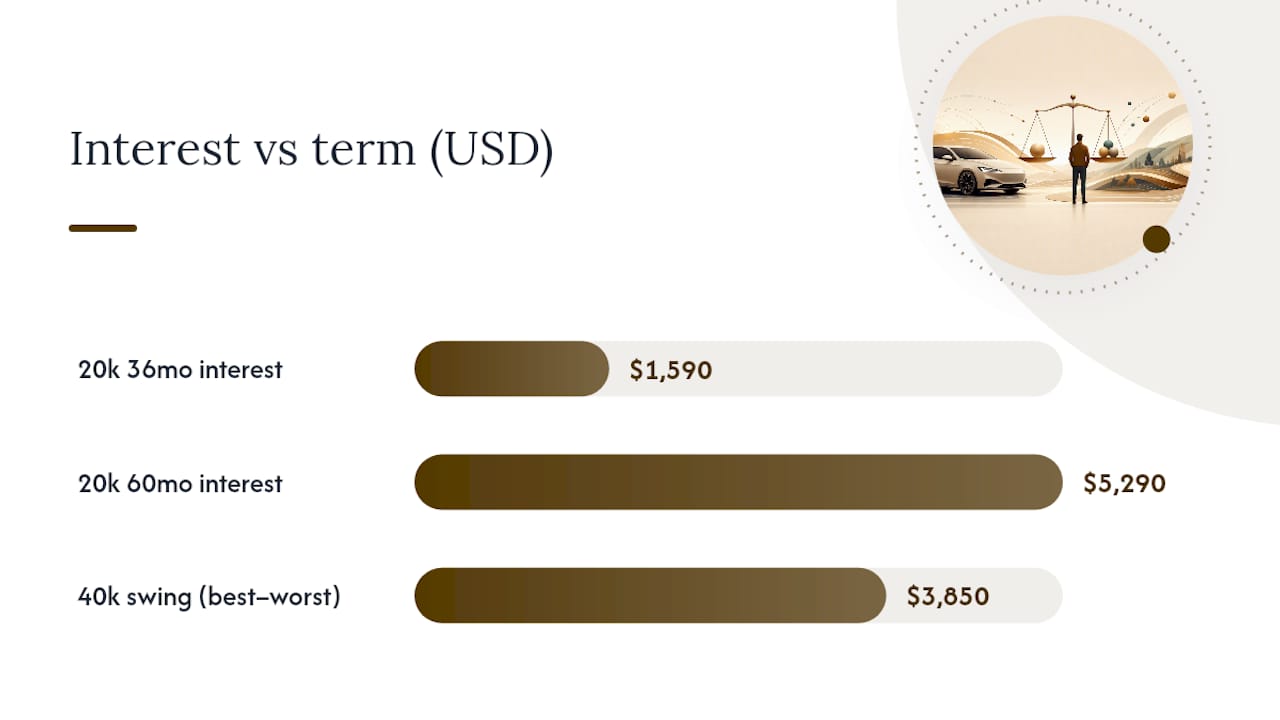
Now shrink the loan to a $20,000 used car over 36 months. At 5% APR, the math works out to roughly $600 a month and about $1,590 in total interest. Stretch that same loan to 60 months and the monthly payment drops to around $382, but total interest climbs to about $5,290, based on a comparable lender amortization example. That’s the trade-off in plain numbers: lower payment, more expensive loan.
That’s not a rounding error; it’s real money sitting on the table if you accept the first number a dealer offers.
Where Does 5% Land Compared to Current U.S. Auto Loan Rates?
Superprime borrowers, generally those with FICO scores above 720, often see new-car offers under 5%, with some credit unions advertising promotional rates in the low 3% to high 3% range for short terms.
Near-prime and subprime borrowers, below 660, often see rates well into double digits regardless of negotiating skill, since the rate reflects real credit risk more than dealer margin.
A few patterns hold across almost every lender:
- Used-car APRs run higher than new-car APRs for the same borrower, often by 0.5 to 1.5 percentage points, because older vehicles carry more collateral risk.
- Longer terms (72 to 84 months) tend to carry higher advertised APRs than 36 or 48-month loans.
- Credit unions like PenFed and Navy Federal frequently publish lower “as low as” rates than big banks or dealer-arranged financing, though those headline rates assume excellent credit and specific vehicle conditions.
These bands shift with the broader rate environment, so treat them as relative positioning rather than fixed numbers. If you want the used-car side broken down further, our used car loan rate benchmarks go deeper into that comparison, and our best used car APR by credit score guide maps specific score ranges to realistic targets.
What Determines the APR a Lender Offers You
Your APR isn’t one number pulled from a chart. It’s the output of several variables layered on top of each other, and understanding which ones you control changes how you negotiate.
- Credit score. This carries the most weight. Moving from the high 600s into the 700s can shave multiple percentage points off your quoted rate.
- Loan term. Shorter terms (36 to 48 months) usually earn lower APRs than 72 or 84-month loans, because the lender’s risk window is shorter.
- Vehicle age and mileage. Older or higher-mileage used vehicles carry higher rates since they depreciate faster and offer less collateral value.
- Down payment and loan-to-value ratio. Putting more money down lowers the amount financed relative to the car’s value, which can nudge your APR down.
- Co-signer. Adding a creditworthy co-signer can meaningfully improve your rate if your own score is thin or bruised.
- Dealer incentives and discounts. Manufacturer-subsidized rates, AutoPay discounts, and credit union membership perks can all shave fractions of a point off the base rate.
Pro Tip: Ask your bank or credit union directly whether they offer a rate discount for setting up automatic payments. It’s often a quarter-point reduction that dealers won’t mention unless you ask.
How to Get Your Car Loan Under 5% APR
Do these in order:
- Get preapproved before you shop. Apply with two or three credit unions or banks so you walk into the dealership with a real written offer in hand, not just a guess at your credit tier.
- Compare credit union and bank rates directly. Institutions like PenFed and Navy Federal often beat dealer-arranged financing for well-qualified borrowers; our credit union auto loan comparison walks through when that holds true.
- Use your best offer as leverage. Dealers can often match or beat an outside offer once they know you have one, since they don’t want to lose the sale over financing margin.
- Ask about manufacturer specials and dealer fees. Some automakers subsidize rates on specific models; separately, confirm no dealer-added fees are quietly padding your APR.
If you’re currently staring down a rate well above 5% and wondering what your options are, our guide on whether 15% APR is fair covers when to push back and when refinancing is the faster fix.
How Baywall Tells You If Your 5% Offer Is Actually Fair
Baywall takes your credit score, vehicle, loan amount, term, and the dealer’s quoted rate, then benchmarks it against comparable real transactions.
- You get a plain fairness label: great, fair, or high.
- You get a target APR to negotiate toward, not just a vague “shop around” suggestion.
- You get an estimated dollar savings figure so you know exactly what pushing back is worth.
Baywall matters most when your offer sits within about a percentage point of what’s typical for your tier, since that’s exactly the range where a dealer markup is easy to miss and hard to spot on your own.
Pro Tip: Run the numbers before you sign, not after. Once the loan is funded, your negotiating leverage disappears.
APR vs. Simple Interest: What You’re Actually Paying For
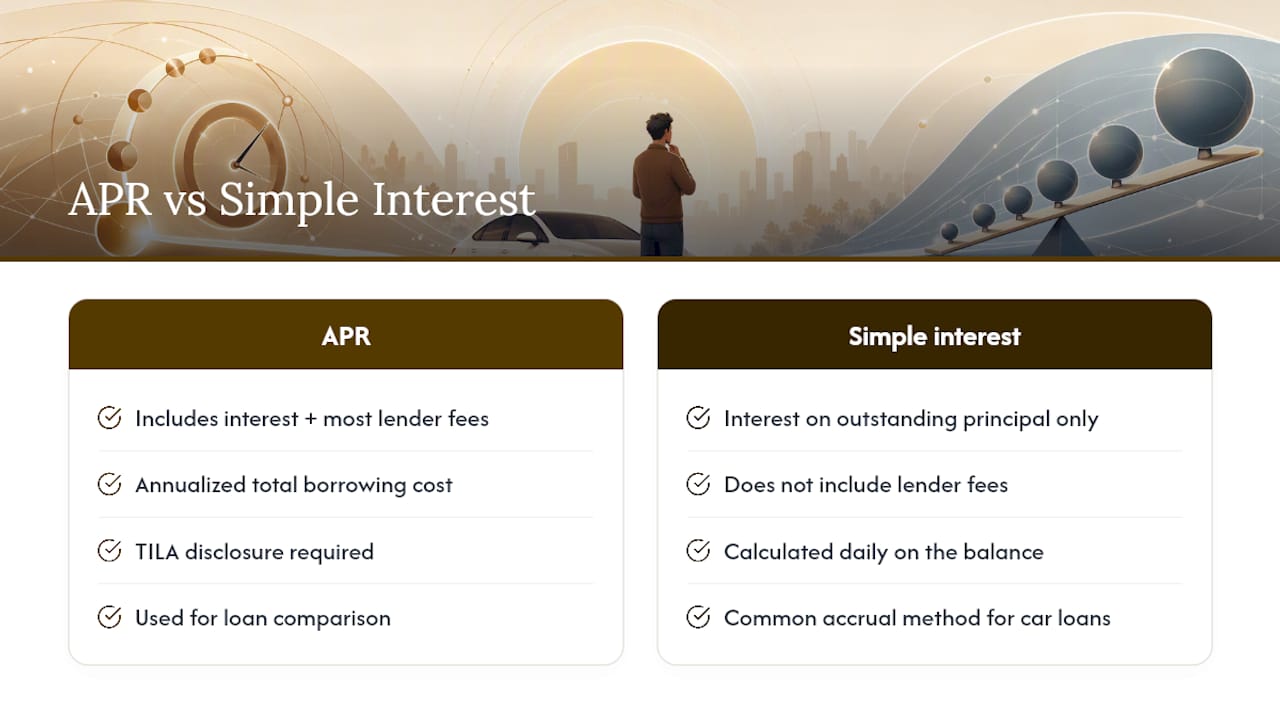
APR, or annual percentage rate, is not the same thing as the raw interest rate on your loan, even though dealers sometimes use the terms loosely. APR represents the total annualized cost of borrowing, folding in the base interest rate plus most lender fees, expressed as a single percentage so you can compare loans apples to apples.
Simple interest, by contrast, is calculated only on your outstanding principal balance each day, without factoring in fees. Most car loans use simple interest to calculate the interest that accrues, while APR is the disclosure number required by the Truth in Lending Act to represent your full borrowing cost. Two loans can carry the same simple interest rate but different APRs if one lender bundles in an origination fee, documentation fee, or other charge that the other doesn’t.
This distinction matters because a lender advertising a slightly lower interest rate isn’t necessarily giving you the cheaper loan. If that low rate comes bundled with a $500 processing fee, the APR, and your real cost, could end up higher than a competitor’s cleaner offer with no fees attached. For a full breakdown of how these two figures diverge on an actual car loan, our APR versus interest rate guide walks through the math side by side.
When you’re comparing offers from multiple lenders, always compare APR to APR, never interest rate to APR. Mixing the two is one of the easiest ways to accidentally choose the more expensive loan while thinking you found the better deal.
Why APR Compounds Over the Life of Your Loan
APR doesn’t just set your monthly payment. It determines how much of every payment goes toward interest versus principal, and that ratio shifts dramatically over the life of the loan. Early payments on any amortizing loan are interest-heavy; later payments are principal-heavy. A higher APR stretches out the period where you’re mostly paying interest, which means more of your early payments do less to reduce what you actually owe.
This creates a compounding effect that gets worse the longer your term runs. Stretch that same loan to 7 years and the gap widens further, because you’re paying a slightly elevated rate over a longer stretch of time.
The practical impact shows up if you ever want to sell or trade in the car before the loan is paid off. A high-APR loan means you build equity more slowly, so you’re more likely to be underwater, owing more than the car is worth, for a longer stretch of the loan term. That’s a real risk if your circumstances change and you need to sell sooner than planned.
This is exactly why total interest cost, not just the monthly payment, deserves your attention when comparing loan offers. A technical look at how amortization schedules work shows precisely how your payment splits between principal and interest month by month.
APR and Interest Rate Aren’t Interchangeable Terms
Car buyers routinely use “interest rate” and “APR” as if they mean the same thing, and dealers rarely correct the confusion because it can work in their favor. The interest rate is the base cost of borrowing the principal. APR layers on top of that, adding in most of the fees the lender charges to originate and service the loan, then expresses the whole package as one annualized percentage.
On most car loans, the gap between interest rate and APR is small, often a few tenths of a percentage point, because auto loans typically carry fewer bundled fees than mortgages. But that gap isn’t guaranteed to be small. A dealer-arranged loan with a documentation fee, an underwriting fee, or an add-on product financed into the loan amount can widen that spread noticeably.
The federal Truth in Lending Act requires lenders to disclose APR specifically so borrowers can compare loans on equal footing, regardless of how each lender structures its fees. That’s the number to anchor on when you’re comparing a credit union offer against a dealer’s financing arm. If a salesperson quotes you an “interest rate” without mentioning APR, ask directly for the APR figure in writing before you sign anything.
What Fees Get Folded Into Your Car Loan’s APR
APR isn’t just your interest rate with a new name. It’s your interest rate plus a set of fees the lender rolls into that single annualized number, and knowing what’s typically included helps you spot when a loan is more expensive than it first appears.
Common fees that can show up inside APR on a car loan include:
- Origination or processing fees the lender charges to set up the loan.
- Documentation fees, sometimes charged by the dealer and financed into the loan amount.
- Underwriting or administrative fees, particularly on loans arranged through a dealer’s financing partner rather than a direct lender.
- Add-on products financed into the loan, like extended warranties or gap insurance, which increase your loan amount and therefore your effective borrowing cost even if they don’t technically count as a “fee.”
Not every lender includes every fee type inside the APR calculation, which is part of why two loans with similar advertised APRs can still cost differently once you read the fine print. A credit union with a straightforward rate and no add-ons might quote a cleaner, more transparent APR than a dealer-arranged loan padded with financed extras.
Always ask for an itemized breakdown of what’s rolled into your APR before signing. If a dealer can’t or won’t explain what’s included, treat that as a signal to slow down and get a second offer from a credit union or bank instead.
Don’t Let APR Tunnel Vision Cost You Elsewhere
Chasing the lowest possible APR is smart, but it’s not the whole picture, and buyers who fixate on that single number sometimes end up worse off overall. A loan with a slightly higher APR but no prepayment penalty, for instance, might beat a marginally lower-rate loan that locks you into rigid terms.
Loan term is the biggest blind spot. Buyers who shop purely on the advertised APR number sometimes get steered into longer terms that look affordable monthly but cost thousands more over the life of the loan.
Total out-the-door price matters just as much as the rate attached to it. Negotiating the price and the financing separately, rather than accepting a bundled “deal,” protects you from that trade-off.
Finally, used-car and private-party financing often carries a visible premium over dealer-arranged new-car offers, so a 5% APR on a used car and a 5% APR on a new car aren’t the same accomplishment. Run the total cost, price, rate, term, and fees together, before deciding a loan is a good deal based on APR alone.
Rate Dispersion Is Wider Than It’s Been in Years
One walks out with a fair deal; the other just left money on the table because they didn’t know their credit tier supported a lower rate elsewhere.
That gap is exactly why benchmarking your specific offer against real comparable deals, rather than a generic published range, matters more now than it used to. Check your number against a Baywall benchmark before you sign.
— Baywall
Get Your Dealer’s Rate Checked Before You Sign
Baywall gives you a straight answer on whether your dealer’s quoted APR is actually fair, based on what buyers with your exact credit tier, vehicle type, and loan term really paid, not a generic published range that doesn’t account for your situation.
Enter your credit score, vehicle, loan amount, term, and the rate you were quoted, and you’ll get a clear fairness label, a target APR to push for, and an estimated dollar savings figure specific to your deal. The basic version is free; a full personalized report with comparable vehicle pricing and negotiation targets runs $2.99. Before you sign your next loan, check your rate against real market data and see exactly how much room you have to negotiate.
Key Takeaways
| Point | Details |
|---|---|
| Credit tier changes everything | Superprime borrowers (720+) should often beat 5% on new cars; prime borrowers around 5% to 7% is normal. |
| Used cars carry a premium | Expect used-car APRs to run 0.5 to 1.5 points above new-car rates for the same credit profile. |
| Term length moves total cost | A 5% rate over 84 months can cost more in total interest than a 6% rate over 48 months. |
| APR includes fees, not just rate | Origination, documentation, and financed add-ons can all widen the gap between interest rate and APR. |
| Benchmark before you sign | Baywall compares your dealer’s quoted APR against real comparable deals and gives you a target rate to negotiate toward. |
This article is general information, not a substitute for advice from a qualified financial advisor. Consult a qualified financial professional about your own circumstances before acting on anything here.
Sources
- Auto Loans - New and Used Car Loan Rates and Calculator
- Auto Loan Calculator - Estimate Car Payments
- Auto Loans & Financing | Navy Federal Credit Union