LendingTree Alternatives for Car Buyers: Get a Negotiation-Ready APR

The best alternative to a generic loan comparison site, when your goal is negotiating a dealer’s APR, is a rate-intelligence benchmark tool that shows you exactly what buyers like you actually paid. Not a list of lenders. Not a prequalification range. A specific target APR tied to your credit score, vehicle, loan amount, term, and location — with the dollar savings spelled out.
Before you sign anything at the dealership, a benchmark report gives you three things a marketplace cannot:
- A target APR calibrated to comparable transactions in your credit tier
- Dollar savings calculated from the gap between the dealer’s quoted rate and the market rate
- Comparable loan data on similar vehicles and terms, so you know what the market actually looks like
Get a benchmark before you sign. That single step is what separates buyers who negotiate from buyers who accept whatever the finance office hands them.
Table of Contents
- Why generic loan comparison sites fall short for dealer APR negotiation
- Practical alternatives that actually help you negotiate a better APR
- How to pick the right LendingTree alternative for your situation
- Step-by-step: using a rate benchmark to negotiate at the dealership
- Costs, timing, and rate context for U.S. car buyers
- When Baywall is the right call and when another route makes sense
- Key Takeaways
- Why benchmarking the dealer’s offer is the move most buyers skip
- Get a negotiation-ready APR benchmark from Baywall
- Useful sources and further reading
Why generic loan comparison sites fall short for dealer APR negotiation
Marketplaces like LendingTree are genuinely useful for initial rate shopping. You can see multiple lenders in one place, and soft-pull prequalification means browsing does not ding your credit score. That convenience has real value.
The problem is what they do not show you. A generic marketplace surfaces a range of lender rates, but it rarely tells you whether the specific APR your dealer quoted is fair for your exact deal. Dealer-quoted APRs can include markups above the lender’s buy rate, and those markups are not visible in a standard lender comparison. The Consumer Financial Protection Bureau notes that dealer financing can include hidden markups not apparent in generic rate offers, which is precisely why transaction-level benchmarking matters.
Generic rates are also not the same as personalized prequalified benchmarks. A marketplace might show you a rate range of 6%–12% for your credit tier. That tells you almost nothing about whether the dealer’s 9.9% offer is fair or inflated. You need a number tied to comparable deals, not a band wide enough to drive a truck through.
Pro Tip: When you sit down in the finance office, ask the dealer to show you the buy rate from the lender before any markup. If they won’t, your benchmark report is the leverage you need to push back.
Practical alternatives that actually help you negotiate a better APR
Not every alternative to a broad comparison site is equally useful for dealer negotiation. Here is how the main categories break down.

| Category | Best for | Dealer APR negotiation value | Typical cost |
|---|---|---|---|
| Rate-intelligence benchmark tool | Buyers who need a specific negotiation target | High — shows target APR and dollar savings | Free basic / ~$2.99 paid report |
| Direct lender marketplace / prequalifier | Comparing lender offers before visiting the dealer | Medium — gives competing offers but no markup analysis | Free |
| Credit union / bank preapproval | Buyers with an existing banking relationship | Medium-high — competing approval letter is real leverage | Free |
| Personal loan (unsecured) | Buyers who cannot get auto financing or need flexibility | Low — higher rates, no vehicle-specific benchmarking | Free to apply |
| HELOC | Homeowners with equity who want low rates | Low for dealer negotiation — different product entirely | Closing costs vary |
| BNPL / fintech credit | Short-term, small purchases only | Very low — not suitable for auto financing | $1–$5 flat fee (EWA) or 10%–36% APR for longer BNPL plans |
A few notes on each category:
- Rate-intelligence tools are the only category built specifically to answer the question “Is my dealer’s APR fair?” They benchmark your offer against real transaction data. Baywall is built for exactly this.
- Direct lender marketplaces give you competing offers, which is useful. But they work best as a complement to a benchmark, not a replacement. Loan comparison sites can surface multiple lenders quickly, though they stop short of telling you whether a specific dealer quote is marked up.
- Credit union preapproval is underrated. Walking into a dealership with a credit union approval letter at 6.5% forces the dealer to beat it or lose the financing. The catch: you need the relationship and the time to apply.
- Personal loans and HELOCs are legitimate personal loan options in specific situations — a HELOC can carry a lower rate than an auto loan if you have significant home equity — but neither gives you a dealer-specific negotiation target.
- BNPL and earned wage access (EWA) are designed for short-term liquidity gaps, not vehicle financing. EWA flat fees of $1–$5 look cheap until you calculate the effective APR on repeated use.
How to pick the right LendingTree alternative for your situation
The right tool depends on what you actually need. Run through this checklist before committing to any platform.
- Does it use transaction-level loan data? Generic rate ranges are not enough. You want benchmarks drawn from real closed loans with comparable credit, vehicle type, and term.
- Does it show a specific target APR? A useful tool names a number you can quote to the dealer, not a range.
- Is the initial inquiry a soft pull? A hard inquiry before you have even chosen a lender costs you credit score points unnecessarily. Most reputable online lending services use soft pulls for prequalification.
- Is a sample report available? Any tool worth trusting shows you what you get before you pay or apply.
- Are the methodology and data sources disclosed? Vague claims about “thousands of lenders” without explaining how rates are calculated is a red flag.
- What does it cost, and is pricing transparent? Free tools often monetize by selling your data to lenders. Paid reports with clear pricing and no lead-gen model are a cleaner arrangement.
Red flags to avoid: no sample data, mandatory hard pull before you see a rate, opaque fee structures, and no explanation of how benchmarks are calculated.
Trust signals to look for: disclosed data sources, soft-pull prequalification, a clear privacy policy, and a sample or preview of the report you will receive.
Step-by-step: using a rate benchmark to negotiate at the dealership
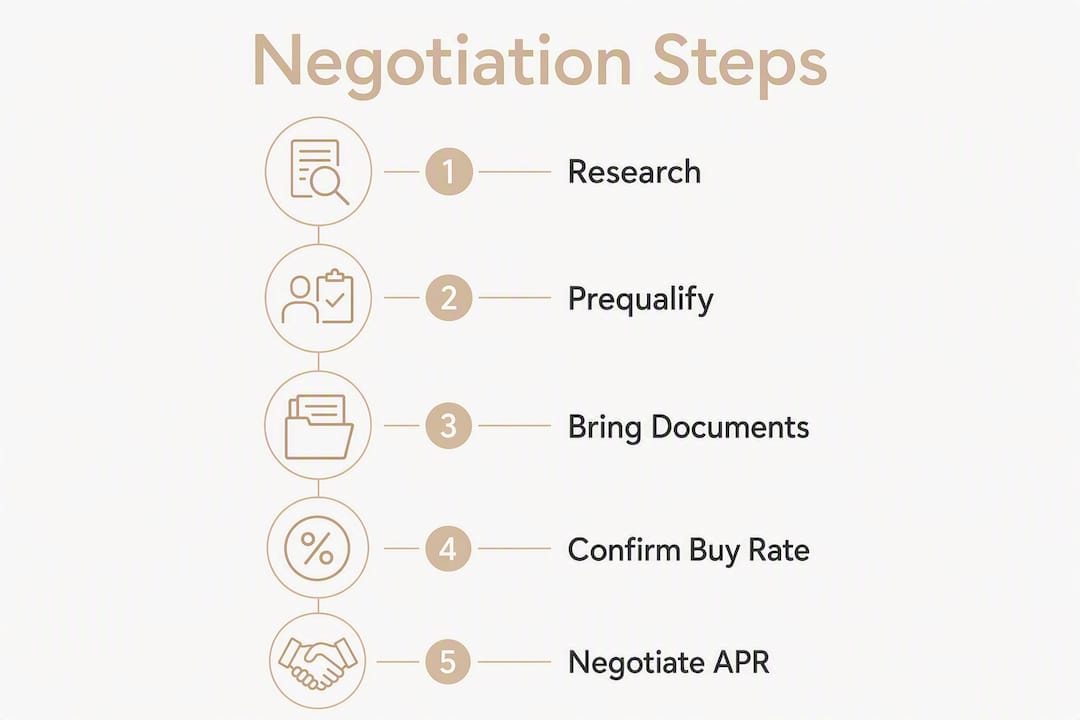
Your benchmark is the target. The conversation at the finance office is where you use it.
- Pull your benchmark before you go. Enter your credit score, vehicle details, loan amount, term, and the dealer’s quoted APR. Your report shows you the market rate for your profile and the dollar gap between the two.
- Separate price from financing. Negotiate the vehicle price first. Once that is settled, move to financing. Mixing the two lets dealers obscure markups in monthly payment math.
- Quote your target APR directly. Say: “I have data showing buyers with my credit profile and a similar vehicle are closing at [target APR]. Can you match that?” You are not guessing. You have a number.
- Show the dollar savings. If the dealer’s rate is higher than your benchmark on a typical loan amount and term, the difference can add up to a substantial amount per month and several thousand dollars over the loan term. That is a number worth saying out loud.
- Get written financing terms before signing. Confirm the final APR, term, and total interest in writing. Ask whether the rate includes any dealer markup above the lender’s buy rate. The CFPB recommends reviewing all financing terms carefully before committing.
Pro Tip: Always confirm whether the dealer’s quoted rate is the lender’s buy rate or a marked-up rate. Dealers are permitted to add a margin, and that margin is negotiable.
Documents to bring: your benchmark report, a government-issued ID, proof of insurance, your credit union preapproval letter if you have one, and recent pay stubs.
Costs, timing, and rate context for U.S. car buyers
Speed and cost vary significantly depending on which route you take.
Rate context: Average credit card rates run substantially higher than fixed personal loan rates, which is why a fixed auto loan or personal loan beats revolving credit for a large, planned purchase like a vehicle.
Timeline by approach:
- Soft-pull prequalification (marketplace): Instant to a few minutes
- Credit union preapproval: Same day to 1–3 business days
- Paid benchmark report (Baywall): Instant delivery after you enter your details
- Personal loan funding: Same day to 3 business days depending on the lender
On cost: most compare lending platforms charge nothing to browse prequalified rates, earning revenue by referring you to lenders. Paid benchmark reports, by contrast, charge a flat fee and do not sell your information to lenders. At $2.99, a Baywall report costs less than a car wash and can save you thousands.
When Baywall is the right call and when another route makes sense
Baywall is the right tool when you need a fast, personalized, negotiation-ready APR benchmark with dollar savings and comparable loan data before you sign. It is built for the buyer sitting across from a finance manager who just quoted 9.9%.
Use Baywall when:
- You have a dealer quote and want to know if it is fair before signing
- You want a specific target APR to quote, not just a lender list
- You need dollar savings calculated so you can make the case to the dealer
- You want instant results without a hard credit pull
Another route may make more sense when:
- You already have a credit union preapproval that is clearly below market and the dealer cannot beat it
- You are financing through a HELOC because you have substantial home equity and want a lower long-term rate
- You are buying from a private seller and need a private-party auto loan rather than dealer financing
The honest answer: for most buyers negotiating at a dealership, a benchmark report and a credit union preapproval letter together are the strongest combination you can bring.
Key Takeaways
A data-driven APR benchmark is the single most effective tool for negotiating a dealer’s financing offer, because it replaces guesswork with a specific, sourced target rate.
| Point | Details |
|---|---|
| Benchmarks beat rate lists | A target APR from comparable transactions gives you a specific number to quote, not a range to guess from. |
| Soft pull first | Vet any platform for soft-pull prequalification before sharing your full credit details. |
| Bring paperwork to the dealer | Your benchmark report, a preapproval letter, and pay stubs give you maximum negotiating leverage. |
| Separate price from financing | Negotiate vehicle price before discussing APR so dealers cannot hide markups in monthly payment math. |
| Baywall delivers instantly | A $2.99 Baywall report shows your target APR, dollar savings, and comparable loan data before you sign. |
Why benchmarking the dealer’s offer is the move most buyers skip
Most car buyers spend hours researching vehicle trim levels and almost no time on financing. That is where the real money gets left on the table. A dealer’s finance office is a profit center, and the APR markup on a single loan can quietly add more to the total cost of ownership than any negotiation over the sticker price.
The conventional wisdom is to “get preapproved before you go.” That is good advice, but incomplete. A preapproval tells you what one lender will offer. A benchmark tells you what the market is offering for your exact profile. Those are different things, and the gap between them is where buyers either save money or give it away.
Baywall’s position is straightforward: every buyer deserves to know whether their dealer’s APR is fair before they sign. The data exists. The calculation is not complicated. The only reason most buyers do not have it is that no one handed it to them before they walked into the finance office.
Get a negotiation-ready APR benchmark from Baywall
Knowing your used car APR benchmarks by credit tier is a start. Getting a report built around your specific deal is what actually moves the needle at the dealership.
Baywall gives you a personalized rate-intelligence report in seconds. Enter your credit score, vehicle details, loan amount, term, and the dealer’s quoted APR. The report shows you whether that offer is great, fair, or high; the exact target APR to negotiate toward; your potential dollar savings over the loan term; and comparable vehicle pricing to strengthen your position further.
The paid report is $2.99 and delivered instantly. There is no lead generation, no lender referral, and no hard credit pull. Just the data you need to walk into the finance office with a number instead of a guess. Run your analysis at Baywall before you sign.
Useful sources and further reading
- Consumer Financial Protection Bureau — dealer markup disclosures, financing term guidance, and credit inquiry behavior
- Experian — credit inquiry behavior, prequalification mechanics, and auto loan rate context