California Auto Loan Rates 2026: What You’ll Actually Pay

California’s average auto loan APR sits at about 7.0% for a 60-month new-car loan if you have a 720+ FICO score, according to CarSavr’s state benchmark data. That’s a national number, though. Credit unions are quoting far better deals: RateAPI’s July 2026 snapshot shows several California credit unions offering rates in the low-4% range on a $35,000, 60-month loan, and California Coast Credit Union advertises rates as low as 4.68% APR for qualifying members.
That gap, roughly 2 to 3 percentage points between the state average and the best credit-union offers, is real money. On a $35,000 loan, it’s the difference between a comfortable payment and one that quietly drains your budget for six years.
Here’s your one move before you do anything else: get pre-approved by a credit union or bank, then run that rate against real market data before you sit down in a dealership finance office. Tools like Baywall benchmark your specific offer against what people with your credit tier actually paid for similar vehicles, so you know whether the dealer’s number is fair or padded.
- California average new-car APR (60 months, 720+ FICO): ~7.0% (CarSavr)
- Best-case credit union APR in California: in the low four percent range (RateAPI)
- Federal oversight backing credit-union rate tables: NCUA
Key Takeaways
| Point | Details |
|---|---|
| State average vs. best rate | California’s 7.0% average new-car APR hides credit-union offers as low as 4.68% for qualifying members. |
| Term length trade-off | Stretching a $40,000 loan from 60 to 72 months at a high rate adds substantially more in total interest. |
| Pre-approval is leverage | A credit-union pre-approval rate gives you a real number to force dealer finance offices to compete against. |
| California cost mechanics | Sales tax basis and trade-in handling can change your out-the-door cost even when APRs look identical. |
| Run a benchmark before signing | Baywall compares a dealer’s exact quoted APR against real transactions in your credit tier, showing your target rate and dollar savings before you sign. |
Table of Contents
- Why California Auto Loan Rates Look the Way They Do
- Current California APR Benchmarks by Loan Type and Term
- What Determines the APR You’ll Be Offered
- Where Californians Should Check and Compare Rates
- Step-by-Step Checklist to Secure the Lowest Reasonable APR
- Worked Examples: What a $40,000 Car Loan Actually Costs
- How a Rate Benchmarking Tool Helps Before You Sign
- Why Most Buyers Never Question Their APR
- Run a Quick Baywall Benchmark Before You Sign
- Where to Check Rates and Verify Your Numbers
- Frequently Asked Questions
- Sources
Why California Auto Loan Rates Look the Way They Do
California isn’t a cheap state to buy a car in, but its auto loan rates are surprisingly competitive. CarSavr ranks California as the 11th lowest-APR state out of 50 states plus D.C., sitting about 0.3 points below the national average. The reason comes down to competition, not luck.
California has a dense network of credit unions competing for borrowers. Academic research on credit-union density found that states with more credit unions per capita tend to see more competitive local lending rates, because credit unions pressure banks and dealer finance offices to match or beat their pricing. When your local Cal Coast branch is quoting 4.68%, a dealer’s finance office has to justify anything above that.
But APR is only half the cost picture in California. The state’s base sales tax runs over seven percent, and how a dealer structures your trade-in and taxable basis can shift your out-the-door cost even when two loans carry identical APRs. A dealer who rolls tax onto the full price before applying your trade-in credit is charging you interest on money you shouldn’t be financing at all.
Watch for these state-specific mechanics before you sign anything:
- Dealer markup (reserve): Dealers can add a margin on top of the wholesale rate a lender gives them, often 1 to 2 points, without clearly disclosing it as markup.
- Documentation fee variability: California doesn’t cap doc fees the way some states do, so amounts vary by dealer and deserve scrutiny.
- Sales tax basis: Trade-in value typically reduces your taxable amount in California, but confirm this is applied correctly on your contract.
Pro Tip: A pre-approved rate from a credit union isn’t just a fallback option. It’s the number that keeps the dealer’s finance office honest, because they know you have a real offer to walk away to.
Current California APR Benchmarks by Loan Type and Term
Rates vary meaningfully by whether you’re financing a new car, a used car, or a private-party sale, and by how long you stretch the loan. Longer terms almost always carry higher APRs because lenders take on more risk over more years, but they also lower your monthly payment. The trade-off is worth understanding before you pick a term just because it fits your budget.
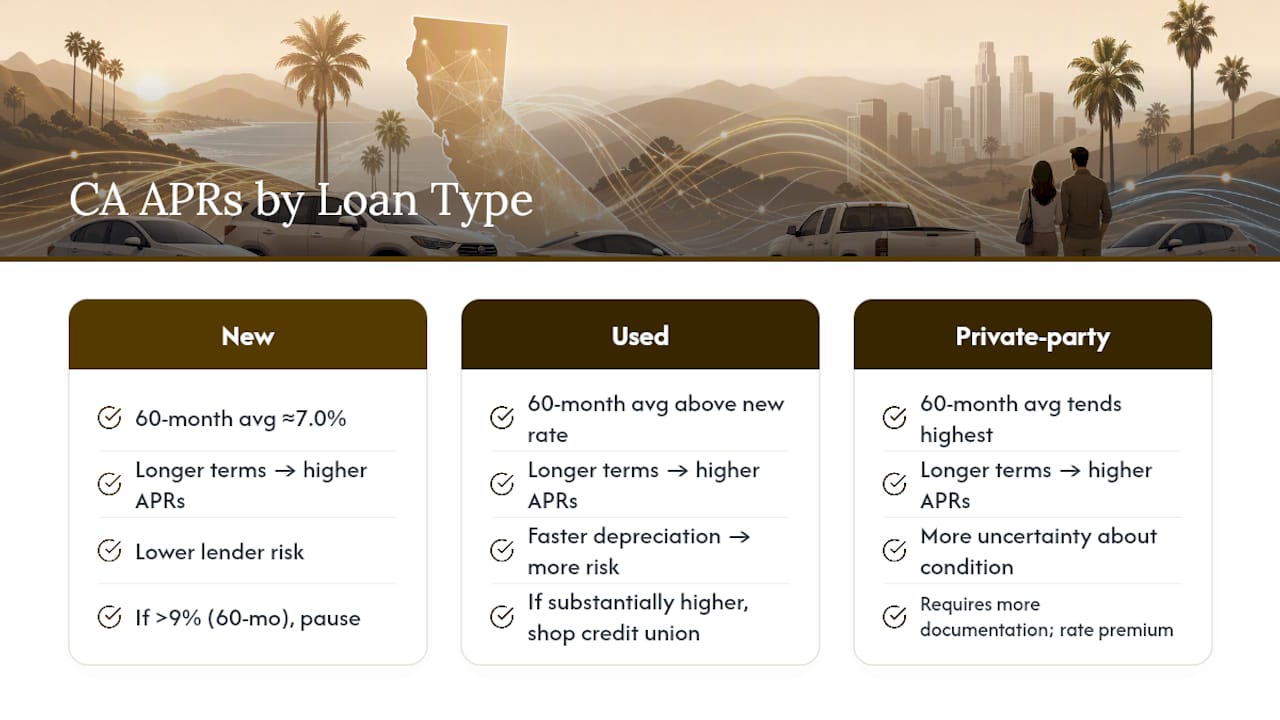
For new vehicles, CarSavr’s data puts the statewide average at roughly 7.0% for a 60-month term among borrowers with strong credit. Used-car loans run higher across the board. MyFinancialPrograms’ used-car rate tables show California used-vehicle APRs consistently above new-car rates at every term length, which is standard nationally since used cars depreciate faster and carry more lender risk.
Here’s how the numbers generally break down by loan type and term:
These ranges reflect what “good,” “typical,” and “high” look like in practice. If you have strong credit and a lender quotes you a new-car rate notably above nine percent on a 60-month term, that’s your signal to pause. If a used-car offer is substantially higher, something’s off, either your credit tier is being misjudged or there’s dealer markup baked in that a credit union pre-approval would have avoided.
Private-party loans tend to have the highest rates because lenders face more uncertainty about the vehicle’s condition and seller’s reliability than with dealer transactions. If you’re buying from an individual, a private-party auto loan usually requires more documentation and carries a rate premium worth budgeting for in advance.
Pro Tip: A useful trigger rule: if your quoted APR sits more than 2 points above the credit-union benchmark for your credit tier and loan type, treat that as a signal to renegotiate or shop elsewhere before signing.
What Determines the APR You’ll Be Offered
Your quoted rate isn’t arbitrary. Lenders run a specific set of criteria through their pricing models, and understanding which ones you can influence changes how you approach the whole car-buying process.
Lenders typically weigh these factors when setting your APR:
- Credit score: The single biggest driver of your rate tier.
- Loan-to-value ratio (LTV): How much you’re borrowing relative to the car’s value; a bigger down payment lowers this ratio and your risk profile.
- Vehicle age and mileage: Older, higher-mileage vehicles carry more lender risk and higher rates.
- Term length: Longer terms generally mean higher APRs.
- Documentation and doc fees: These add to your total cost even when they don’t show up in the advertised APR.
- Dealer markup: The margin a dealer adds on top of the wholesale rate the lender actually offered them.
Credit score bands shape your expectations more than anything else on this list. Borrowers in the excellent tier (generally 720 and above) see the rates closest to the benchmarks above. Good credit (typically 660 to 719) usually means a modest premium over those numbers. Fair credit (around 600 to 659) often pushes APRs several points higher, and poor credit can mean rates that make the loan itself questionable as a financial decision. If you fall into a lower tier, understanding used-car APR expectations by credit score helps you set realistic goals rather than walking in blind.
Here’s what you actually control before you ever step into a dealership:
- Timing: Shop for pre-approval before you shop for the car, not after.
- Down payment: A larger down payment improves your loan-to-value ratio and often unlocks better pricing tiers.
- Term selection: Choosing a shorter term when you can afford the payment reduces total interest paid.
- Pre-approval: Walking in with a bank or credit-union offer in hand gives you leverage.
- Co-signer: A creditworthy co-signer can move you into a better rate tier if your own credit is thin or damaged.
One distinction trips up a lot of buyers: the advertised APR you see on a lender’s website is not the same as what you’ll pay once dealer finance markup and fees enter the picture. Learning to separate APR from the underlying interest rate and the fees stacked on top is the difference between comparing offers accurately and getting talked into a worse deal that looks fine on paper.
Where Californians Should Check and Compare Rates
You have four realistic places to shop for a car loan, and each one serves a different purpose depending on where you are in the buying process.
Credit unions tend to offer the most competitive rates in California, largely because of the density issue covered above. California Coast Credit Union publishes rates as low as 4.68% APR for qualifying members, and membership requirements are often easier to meet than people assume. The tradeoff: you typically need to join before you can borrow, which takes a small extra step most bank customers skip.
National banks like Bank of America offer convenience and often pre-existing relationships if you already bank there, which can speed up approval. Their rates are usually competitive but rarely beat a strong credit union offer. Bankrate’s weekly rate surveys are a solid starting point for tracking where national averages sit before you approach any specific lender.
Online lenders and marketplaces move fast and let you compare multiple offers without visiting a branch, which suits buyers who want quotes in a single afternoon. The catch is that not every online lender discloses fees as clearly as a credit union’s published rate table does.
Dealer-arranged financing is convenient because it happens in the same room where you’re buying the car, but it’s also where markup lives. Dealers earn a commission on the spread between the wholesale rate a lender offers and what they quote you.
When comparing across these sources, match the exact same inputs every time: loan amount, term, vehicle model year, and your actual credit tier. A rate quote for a 36-month loan means nothing next to a 72-month quote. And factor in how each lender treats your trade-in and down payment. A loan-to-value comparison only works when you’re holding every variable constant except the lender.
Step-by-Step Checklist to Secure the Lowest Reasonable APR
Getting a good rate in California isn’t about luck or charm in the finance office. It’s a sequence, and skipping steps is how buyers end up overpaying.
- Check current benchmarks and get pre-qualified with two or three lenders. Start with a credit union like Cal Coast or Golden 1, then compare against a national bank. Pre-qualification usually involves a soft credit pull that won’t ding your score.
- Run a rate benchmark before you commit. A tool like Baywall compares your specific offer, credit tier, vehicle, and loan amount against real transactions from similar buyers, so you know your target number before you negotiate.
- Set your out-the-door price ceiling first. Decide the maximum total you’ll pay, including tax and fees, before you talk financing at all.
- Negotiate the vehicle price separately from financing. Dealers prefer to blend these conversations because it hides where the money moves. Settle the price, then discuss the loan.
- Read the final finance contract line by line before signing. Confirm the APR matches what was verbally quoted and that no add-ons were rolled in without your explicit agreement.
When you’re in the finance office, a simple script goes a long way: “I’m pre-approved at [your rate] through [your lender]. If you can beat that, I’ll finance here. If not, I’ll use my own financing.” That single sentence puts the burden on the dealer to justify their number instead of you having to justify pushing back.
Watch for these red flags before you sign anything:
- Documentation fees that seem high relative to what you’ve seen quoted elsewhere in California.
- An APR that lands more than 2 points above your credit-union benchmark with no clear explanation.
- Add-ons like extended warranties or gap insurance quietly rolled into the loan amount without a clear yes or no from you.
Total cost of credit matters more than the headline APR alone. A Cal Coast loan cost calculator illustrates this well: two loans with nearly identical APRs can differ by hundreds of dollars in total cost once fees and tax handling are factored in. Always ask for the total finance charge over the life of the loan, not just the rate.
Worked Examples: What a $40,000 Car Loan Actually Costs
Numbers make this concrete. Take a $40,000 loan and run it at three APR scenarios, good, average, and high, across the most common terms.

Here’s how a $40,000 loan at 60 months and 7.0% APR is calculated. First, the APR converts to a monthly rate by dividing by 12, giving you roughly 0.583% per month. That monthly rate applies to your remaining balance every payment cycle. Over 60 months, the loan amortizes so that early payments are weighted more toward interest and later payments toward principal, landing at a monthly payment near $792 and about $7,500 in total interest by the time the loan is paid off.
Notice what happens between the 60-month average scenario and the 72-month high scenario: the monthly payment actually drops by about $72, but total interest jumps by over $4,300. That’s the real cost of stretching a loan to lower your payment.
These figures assume the $40,000 reflects your actual financed amount after tax, fees, and trade-in credit are applied. If a dealer rolls unpaid negative equity from a trade-in into your new loan, your effective balance climbs above $40,000 even though the sticker price on the new car stayed the same, and every number in this table shifts upward with it.
How a Rate Benchmarking Tool Helps Before You Sign
Pre-approval tells you a baseline rate. It doesn’t tell you whether that rate, or the dealer’s counteroffer, is actually competitive for someone with your exact credit profile, vehicle, and loan structure. That’s the gap a benchmarking report closes.
A tool like Baywall pulls together:
- A benchmark APR based on real transactions from buyers in your credit tier with similar loan types.
- A target APR representing what you should realistically be pushing toward in negotiation.
- Comparable loan data showing what similar vehicles and loan amounts have gone for recently.
- A dollar-savings estimate quantifying exactly what a better rate would save you over the life of the loan.
Picture this scenario: a buyer walks into a dealership pre-approved at about seven and a half percent through their bank. The dealer’s finance office counters with a higher rate close to nine percent, framing it as a special promotional rate. Armed with that number, they go back to the finance office and either get the dealer to beat their bank’s rate or walk out and finance with the bank instead. That’s the entire value of the last-check step.
The right moment to run this kind of benchmark is after you’ve secured pre-approval but before you sign the dealer’s paperwork. It costs you a few minutes and can save you thousands over a 60-month term.
Pro Tip: Run your benchmark with the dealer’s exact quoted numbers, not your pre-approved rate. You want to know if their specific offer is fair, not just whether your bank’s rate was reasonable.
Why Most Buyers Never Question Their APR
Most car buyers treat the APR their dealer quotes as a fact rather than an opening bid. That’s backward, and it costs Californians real money every year. Dealer finance offices operate on a simple incentive: the spread between the wholesale rate a lender actually offers and the rate they quote you is often their profit, and buyers rarely push back because they don’t have a number to compare against.
What surprises people most isn’t that markup exists. It’s how invisible it is. A dealer doesn’t hand you a document that says “we added 1.5 points here.” They hand you a number, framed as competitive, and count on you not having a benchmark to check it against. Pre-approval helps, but even pre-approved buyers often accept a dealer’s counteroffer without confirming whether it’s genuinely better or just cleverly worded.
The fix isn’t complicated. It’s knowing your number before you walk in, and having a way to verify a dealer’s counteroffer against real market data instead of taking their word for it.
Run a Quick Baywall Benchmark Before You Sign
You’ve done the research. You know California’s rate landscape, you understand what drives your APR, and you’ve probably already lined up pre-approval from a bank or credit union. The one step most buyers skip is to check whether the dealer’s actual counteroffer holds up against what people with your credit profile and vehicle actually paid.
Baywall’s report gives you a benchmark APR, a specific target rate to negotiate toward, and a dollar-savings estimate based on comparable transactions, not a generic national average. Say a dealer quotes you 8.9% on a $35,000 loan. A free basic version gets you started, and the full $2.99 report gives you the complete negotiation picture. Run your benchmark now before you sign anything at the dealership.
Where to Check Rates and Verify Your Numbers
- CarSavr California data: State-level APR benchmarks by term and credit tier. Carsavr
- RateAPI credit union rates: Live comparison of California credit-union APRs by loan amount and term. Rateapi
- California Coast Credit Union: Published member rates and eligibility terms. Calcoastcu
- NCUA: Federal regulator overseeing credit unions and consumer protections. Ncua
- HUD: Federal consumer protection resources relevant to broader lending context. Hud
- Bankrate: Weekly national auto loan rate surveys for tracking market movement. bankrate.com
Frequently Asked Questions
What is a good auto loan interest rate in California right now? For borrowers with excellent credit (720+), a good rate on a new car falls between 5.5% and 7.0% depending on term length, per CarSavr’s benchmark data. Credit unions like Cal Coast sometimes beat even that range for qualifying members.
Are used car loan rates higher than new car rates in California? Yes. Used-car APR tables consistently show rates 1 to 3 points above new-car benchmarks at every term length, largely because used vehicles carry more lender risk.
Should I get pre-approved before visiting a dealership? Yes. Pre-approval gives you a concrete rate to compare against the dealer’s offer, and it’s the single most effective negotiating tool you can bring into a finance office conversation.
How much does my credit score actually affect my rate? Substantially. Borrowers in the excellent tier see rates closest to published benchmarks, while fair or poor credit tiers often face APRs several points higher, sometimes enough to change whether the loan makes financial sense at all.
Does California cap dealer documentation fees? California doesn’t impose a statewide doc-fee cap the way some states do, so amounts vary by dealer. It’s worth comparing this fee across dealerships the same way you compare APRs.
How does a Baywall report differ from just checking a bank’s advertised rate? A bank’s advertised rate is a general starting point. Baywall benchmarks the exact APR a dealer quotes you against real transactions from buyers with your specific credit tier, vehicle type, and loan amount, giving you a personalized target rather than a generic number.
Sources
- California Auto Loan Rates 2026: 7.0% Avg APR — 11th lowest-APR state (50 states + D.C.) | CarSavr
- Best Credit Union Auto Loan Rates in California — New & Used Car, July 2026 | RateAPI
- Auto Loans as low as 4.68% APR | California Coast Credit Union
- Ncua
- Hud