Auto Loan Credit Tiers: 2026 APR Bands and Action Plan

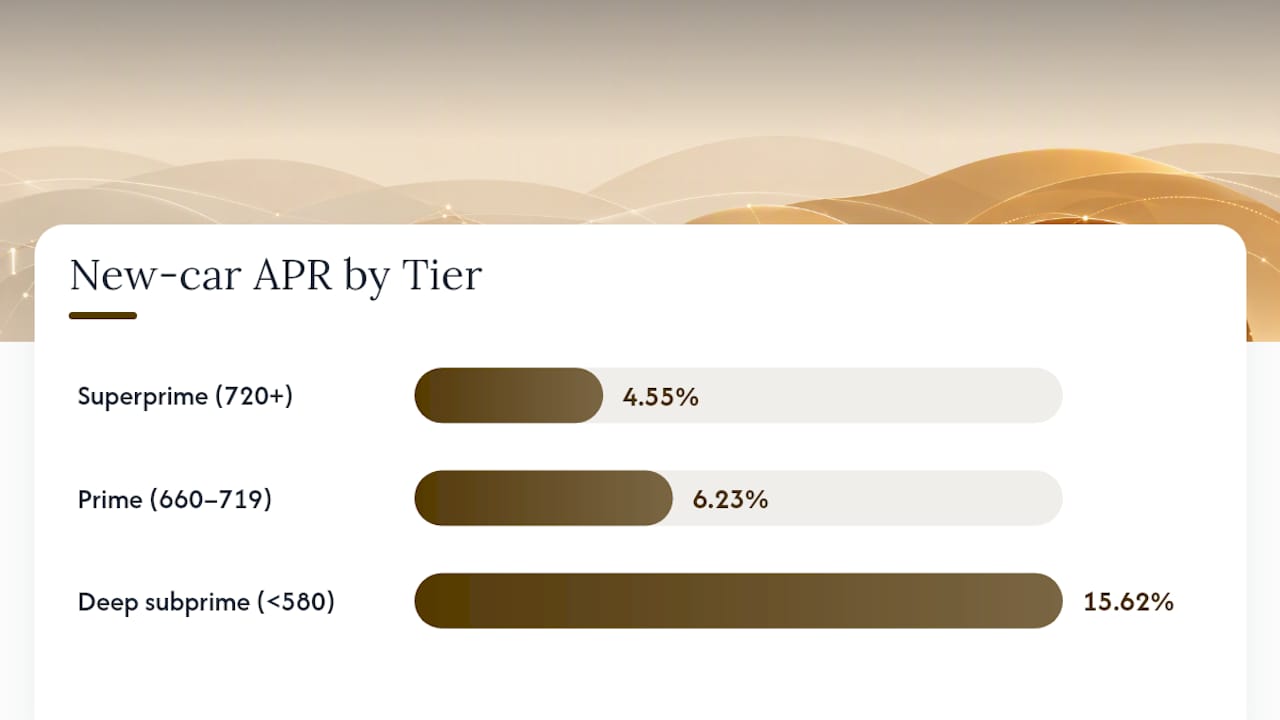
Your credit score sorts you into one of roughly seven auto loan credit tiers, and the difference between tiers can swing your APR by two to six percentage points. A superprime borrower (720+) typically sees new-car APRs around 4.55% and used-car APRs near 6.30%, while Experian’s tier data shows deep subprime borrowers (below 580) often paying rates in the mid-teens or higher. Before you talk to a dealer, pull your credit reports at annualcreditreport.com and get at least one preapproval from a bank or credit union.
- Superprime (720+): New ~4.55% / Used ~6.30%
- Prime (660–719): New ~6.23% / Used ~8.77%
- Nonprime (620–659): New ~9.62% / Used ~13.05%
- Subprime (580–619): New ~13.32% / Used ~18.02%
- Deep subprime (below 580): New ~15.62% / Used ~21.32%
Pro Tip: Check your score before you shop, not after the dealer runs it — a 20-point swing can put you in a different tier and change your monthly payment by real money.
Key Takeaways
Moving up one auto loan credit tier before financing, rather than settling for your current score’s average rate, is the single highest-leverage move available to most car buyers.
| Point | Details |
|---|---|
| Pull your reports first | Check all three bureaus at annualcreditreport.com and dispute errors within the first week. |
| Cut utilization below 10% | Pay down revolving balances before your statement closes to help your score before you apply. |
| Freeze new credit for 90 days | Avoid new applications so inquiries and new accounts don’t offset your utilization gains. |
| Get soft prequals, not one hard pull | Compare three to four lenders, then consolidate hard inquiries into a 14-day window. |
| Benchmark before you sign | Run the dealer’s quoted APR against real comparable data to know your target rate and savings. |
Table of Contents
- Understanding Auto Loan Credit Tiers and Staircase Pricing
- What Shapes Your Offer Beyond the Credit Score
- A 90-Day Plan to Move Up a Credit Tier
- How to Rate-Shop and Negotiate Like You Mean It
- Turning Your Tier Into a Negotiation Number With Baywall
- Refinancing After Your Credit Tier Improves
- Why the Tier Chart Isn’t the Whole Story
- Sources
Understanding Auto Loan Credit Tiers and Staircase Pricing
Lenders don’t price loans on a smooth curve. They sort applicants into buckets, and your APR is set by which bucket you land in, not by your exact score. This is why a borrower at 660 and a borrower at 720 can get meaningfully different offers even though both technically qualify as “good credit” to most people.
Auto lenders generally use tier boundaries close to these: superprime (720+), prime (660–719), nonprime (620–659), subprime (580–619), and deep subprime (below 580). Some lenders slice further, adding a near-prime band around 620–660. The exact cutoffs vary by lender, but the pattern holds across the industry: your score doesn’t just nudge your rate, it can jump it.
That’s the staircase effect. Move from 660 to 661 and you might not change tiers at all. But move from 689 to 720, crossing from prime into superprime, and you could see your APR drop by several percentage points overnight. CarSavr’s tier analysis documents this pattern consistently across lenders: the boundary matters more than the raw number.
Here’s what that means in dollars. On a typical mid-size auto loan, moving from prime into superprime can save you a significant amount in interest across a standard 60-month term. Experian’s data puts average new-car APRs at 6.23% for prime borrowers versus 4.55% for superprime, and that gap compounds every month you carry the loan.
- New-car APR averages run roughly 4.55% (superprime) to 15.62% (deep subprime)
- Used-car APR averages run roughly 6.30% (superprime) to 21.32% (deep subprime)
- Nonprime and subprime borrowers see the steepest jumps between adjacent tiers
What Shapes Your Offer Beyond the Credit Score
Your tier sets the range, but the number on your contract depends on several other factors working together. Dealers often add a markup, sometimes called dealer reserve, on top of the rate the lender actually approved. The FTC’s consumer guidance recommends comparing a dealer’s quote against outside financing before signing anything, because that markup is legal but rarely disclosed upfront.
Beyond the markup question, underwriters weigh several variables inside your tier:
- Debt-to-income ratio: High existing debt can push your quoted rate toward the top of your tier’s range.
- Employment history: Less than two years at your current job can trigger a rate bump or a request for a co-signer.
- Loan-to-value ratio: Financing more than the car is worth (rolling in negative equity, for example) raises lender risk and your rate.
- Loan amount and term: Longer terms often carry higher rates because the lender’s risk window extends.
- Co-signer presence: A co-signer with strong credit can move your effective offer toward a better tier’s pricing.
Watch for manufacturer promotional financing, too. A 0% or 1.9% offer from the automaker’s captive lender can beat every tier’s average rate, but usually only applies to specific trims and shorter terms, so read the fine print before assuming it’s automatically your best deal.
Pro Tip: Ask the finance manager directly: “What’s the buy rate from the lender, and what are you marking it up to?” Dealers aren’t required to volunteer this, but many will answer if you ask plainly.
A 90-Day Plan to Move Up a Credit Tier
Jumping one tier before you finance can be worth more than years of routine on-time payments, because a single boundary crossing changes your entire pricing bracket. Here’s a sequence that tends to produce measurable results within three months.
- Days 0-7: Pull all three credit reports through annualcreditreport.com and dispute every error you find, including outdated collections, duplicate accounts, and incorrect balances.
- Days 7-45: Pay down revolving balances until your utilization sits below 10%. Time payments to land before your statement closing date so the lower balance actually reports.
- Days 45-90: Freeze new credit applications entirely. Avoid opening store cards or new loans, and if you have access to a family member’s older, well-managed card, ask about becoming an authorized user.
CarSavr’s 90-day playbook and industry analysts suggest disciplined execution of these three steps can lift a score by 20 to 40 points for many borrowers, sometimes enough to cross a tier boundary entirely.
Run the math on what that’s worth. On a $35,000 loan at a 60-month term, moving from nonprime into prime, roughly a three-point APR drop, can save well over $2,500 in total interest. That’s real money sitting on the table if you finance before doing this work.

Pro Tip: Dispute resolutions typically take 30 days under federal law, so file disputes on day one. Waiting even two weeks to start can push your improved score past your target purchase date.
How to Rate-Shop and Negotiate Like You Mean It
Getting soft prequalification quotes from three or four lenders, banks, credit unions, and online lenders alike, costs you nothing in score points. NerdWallet’s guidance confirms these soft pulls don’t affect your credit, which means you can shop broadly before you ever set foot on a lot. When you’re ready to formally apply, consolidate every hard inquiry into a 14-day window; scoring models treat clustered auto inquiries as a single search rather than several separate credit events.
Once you have offers in hand, compare them on more than the monthly payment:
- APR, not just the advertised rate
- Total finance charges across the full term
- Fees, including origination or documentation charges
- Term length, since a 72-month loan can look cheap monthly but cost thousands more overall
If a dealer’s quote comes in above your best outside offer, say so directly: “My credit union preapproved me at [rate]. Can you beat that, or should I finance through them?” This single sentence, backed by a real written offer, does more negotiating for you than any amount of haggling over the sticker price. Comparing APR against the nominal interest rate also matters here, since a lower “rate” with high fees can still cost more than a slightly higher APR with none.
Pro Tip: Bring your preapproval letter printed, not just mentioned. Finance managers negotiate differently when they see a real competing number on paper.
Turning Your Tier Into a Negotiation Number With Baywall
Knowing your tier tells you a range. Baywall tells you the specific number to ask for. You enter your credit score, the vehicle, loan amount, term, and the dealer’s quoted APR, and Baywall benchmarks it against real transactions from buyers in your same tier and loan type.
The report labels the offer great, fair, or high, and hands you a target APR along with your estimated dollar savings if you push back. Baywall’s 2026 SUV benchmark data covers both new and used vehicles across every major credit tier, so the comparison reflects actual market pricing rather than a generic average.
- Enter your score, vehicle, loan amount, term, and dealer’s APR
- Get a great/fair/high label plus a specific target rate
- Print the report and hand it to the finance manager as your counteroffer
Refinancing After Your Credit Tier Improves
Your loan doesn’t lock you into your original tier forever. If you financed while sitting near a tier boundary, refinancing six to twelve months later, once your score has climbed, can meaningfully cut your remaining interest.
The math works because refinancing essentially restarts the tier assessment. A lender pulls your current score, current income, and current loan-to-value ratio (which has improved simply because you’ve paid down principal), and reprices accordingly. If you crossed from nonprime into prime during that window, you may qualify for a rate two to four points lower than what you originally signed.
Timing matters more than most borrowers realize. Refinance too early, before your score has actually moved, and you’ll likely get the same rate with a new set of fees. Wait too long, and you’ve paid unnecessary interest for months you didn’t need to. NerdWallet’s research recommends checking your prequalified rate every few months once you’re actively working to improve your score, since soft pulls cost nothing and give you a real-time read on whether refinancing makes sense yet.
One caveat: refinancing resets your loan’s amortization schedule. Even at a lower rate, stretching remaining payments over a new term can increase total interest paid if you’re not careful about matching or shortening the term relative to what’s left on your original loan.
Why the Tier Chart Isn’t the Whole Story
The tier tables everyone cites, including the ones in this article, describe averages. They don’t describe your specific deal, and treating them as a guarantee is where a lot of borrowers go wrong. A “prime” borrower with a high debt-to-income ratio and a 75-month term can easily pay more than the average nonprime borrower with clean underwriting elsewhere.
The conventional advice to “just improve your score” also undersells how much boundary position matters more than raw point totals. A 705 score sitting comfortably inside the prime tier gains you nothing over a 662 score in the same tier. The 90-day playbook in this guide exists because crossing a boundary, not accumulating points within one, is where the savings actually live.
What we’d prioritize first: get your preapproval before you set foot on a lot, and run any dealer quote against real comparable data rather than trusting a chart alone. Averages tell you what people like you typically pay. A benchmark tool tells you what you specifically should be paying on this loan, this week, in this market.
— Baywall
Sources
- What Is a Good Credit Score for an Auto Loan? | Experian
- Financing or Leasing a Car | Consumer Advice (FTC)
- Average Car Loan Interest Rates by Credit Score - NerdWallet